



Certain witty and erudite public figures here in the UK have an annoying habit of making somewhat ignorant pronouncements on anthropogenic climate change, preferring to deny that it's happening at all rather than talk about the more complicated (and valid) issues of how badly it might affect us (or not), or what mixture of adaptation and mitigation would best serve us. Jeremy Clarkson is one such person. The Radio 2 DJ Terry Wogan is another. Despite his form, I was intrigued by one item of discussion (or, more accurately, lengthy mockery) on his breakfast show this morning, namely that in the stormy weather that we're currently enjoying, 'it's too windy for the wind turbines!' Ha ha ha.
It turns out that wind turbines are shut down at wind speeds above about 65 mph, because the faster rotation of the blades at high wind speeds can either overheat the generator, or cause 'overspeed' problems whereby the blade rotation becomes impossible to control or stop (see p20 of this pdf). This is a simple consequence of optimising the turbines to the usual (slower) wind conditions, but it does raise an important issue. Other forms of renewable energy such as wave and solar are also compromised by stormy weather, meaning that during a serious storm, even without damage to the distribution system a renewables-heavy generation mix could well leave a lot of us without power.
To avoid such problems, you either need enough non-renewable (nuclear, gas, coal) capacity to act as a backup, which places fundamental (low) limits on renewable generation, or you need to somehow store the energy produced by the renewables in better weather. The latter is currently impractical at a large scale, which is one argument in favour of distributed generation (where batteries and heat sinks can be used). However, it seems that people are experimenting with using wind generators to produce hydrogen fuel. Using renewable power to produce energy-rich chemicals would be an interesting way of getting round the problem; in pure speculation mode, I wonder if you could use wind turbines to turn atmospheric CO2 back into hydrocarbons?
11 January, 2007
Too windy for wind turbines?

27 October, 2006
Glass house shatters due to mass casting of stones, more at 11
I’ve been meaning to mention the report released last week by the Environmental Change Institute, which argues that the government’s policies for the expansion of air travel rather get in the way of their attempts to seriously curtail CO2 emissions (click here for pdf). However, the lack of any substantive response from the government (at least, I didn’t see one) meant that beyond agreeing that all the sound and fury about nuclear generation (or not) is beside the point if we don’t hit the other areas of our energy use – a point that I’ve made myself before – I didn’t have much to add.
However, I think another story, which has been gathering momentum in the media over the last few days, gives us all something to consider. It involves my place of work. From here:
The National Oceanography Centre in Southampton is home to a £20 million research program on the dangers of rapid climate change. It also houses the southern office of the Tyndall Centre for Climate Change Research. But while its staff are investigating the impact of carbon emissions on our climate, their bosses enjoyed a trip to America with their wives last weekend on a private jet.
Ed Hill (Director of the Centre), Andrew Roberts (Head of the University of Southampton School of Ocean and Earth Sciences) and Bill Wakeham (Vice-Chancellor of the University) flew from Southampton to North Carolina with various other hangers-on. Their private jet was provided by an American businessman that they were courting (and presumably they did not want to offend this would-be philanthropist by insisting on taking scheduled flights) [this is incorrect –see below]. As a result, their journey put several times more carbon per passenger into the upper atmosphere than using a regular airline.
Several staff that I have spoken to from the Centre who are working on the dangers of climate change feel betrayed by this affair. The "do as I say, not do as I do" example of the their bosses undermines their credibility when highlighting the need to reduce carbon emissions. It also hands ammunition to those denying climate change and suggests that the principles of those involved are for sale to anyone who offers to write a cheque.
Indymedia also has an update to this story – surprisingly, I can’t find much else online, although there is a discussion at Stoat.
In public relations terms, this is a complete own-goal, and it’s very easy to take the self-righteous line being adopted by most of the reports I’ve seen or heard about (the second Indymedia link being a good sampling of the general tone). I’m hoping some of them at least got the facts straight - the purpose of the trip was to set up a long-term
More prosaically: you have to go to Edinburgh for a couple of days next month. You look up train fares from Southampton, and find a return costs £114.00. You can fly from Southampton airport, in far less time, for £65 (I’ve just looked up these prices). Which would you choose?
In the context of this post, most people would probably plump for the more environmentally friendly options, but I’m honest enough to admit that if I didn’t think anyone was looking, I’d be sorely tempted by the option that got me there cheaper and faster. I would definitely feel bad about it at some level, but that might not stop me doing it. And herein lies the problem we face. The Environmental Change Institute’s report highlights but one facet of what is a pervasive feature of modern life: the environmentally ‘bad’ options are the easy and/or convenient and/or accepted ones. Absurd as it seems, you can get around the UK fastest and most cheaply by flying; imported vegetables in Tescos are cheaper than the ones grown locally; you can have a cheaper (and sunnier, probably) holiday by flying to Spain, or further, than you can in the UK; and, in most places, it is easier and cheaper to drive to work than get the bus. Those who try hardest to reduce their environmental impact – by not owning a car, not going abroad for their holidays - are also viewed as slight eccentrics. It is only when these circumstances, and attitudes, begin to change that we have a hope of getting a grip on our greenhouse gas problem.
Returning to the NOC story, then, the question here is not about private jets, but whether a face-to-face meeting was required in the first place. And if the current furore was not being fuelled as much by reverse snobbery and envy as real environmental concern, that is the question that people would be asking.
01 September, 2006
The long road to ozone hole recovery
I'm somewhat late commenting on the story that the Antarctic ozone hole appears to have stopped growing, but I put together this figure last week by pulling images off the NASA Ozone Hole Watch website (click here for the latest image from this year), and it seems a shame to waste it. It depicts how the springtime concentration of ozone over the south pole has varied since 1979. Blue and purple indicate low ozone concentrations, green and yellow high concentrations. 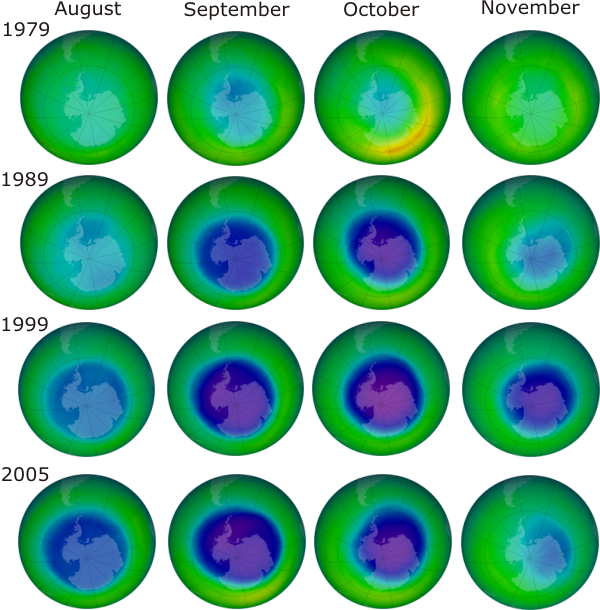
This figure provides a qualitative impression - that the area of ozone depletion in the 2005 season was not enormously bigger or deeper than in 1999, and in fact appeared to recover a little earlier. This impression is confirmed by the more rigorous (but less pretty) figure below, which shows the annual variation in the size of the ozone hole since 1979 - click on it for the original (and clearer) version at this NASA site, where you can also see how the severity of ozone depletion has varied. 
So it seems that in fact things have been stabilising for a while now - the sudden media interest can be traced to a NOAA press release to mark the 20 year anniversary of the study that confirmed that chlorine, released when CFCs are broken down by ultraviolet radiation, was the cause of ozone depletion above Antarctica. This work combined with a rare outbreak of non-partisan international cooperation to produce the Montreal Protocol. Even more remarkably, the agreement was actually pretty effective at curtailing the production of CFCs and other ozone-damaging chemicals: 
(source)
However, the important thing to notice is that the thinning of the ozone layer above Antartica continued throughout the 1990s; although we cut the production of ozone-destroying chemicals, the molecules of those we have already released are persistant beasties, surviving in the atmosphere for anything up to 100 years. Indeed, as the graph here shows, the atmospheric concentration of flourocarbons has merely stablised in the last decade. Until it begins to fall, springtime ozone depletion above the Antarctic will continue (the latest research estimates full recovery in about 2065). The fact that our atmosphere is still suffering the consequences of CFC emitted two decades ago is a warning about the consequences of the other changes we have wrought on atmospheric chemisty. Even if we can agree to seriously cut the emission of greenhouse gases in the next decade or two, the full effect of what we've already emitted, and are currently emitting, will not play out for a long time afterwards (especially since climate change affects the ocean, which responds over timescales of centuries, not decades). More people need to realise that emissions cuts will not put the brakes on climate change; it is more akin to taking your foot off the accelerator.

18 July, 2006
Energy review says nothing much
Oooh, the government must be afraid of me. Why else would they choose to wait until I was away to release their new, improved energy review? Get the full details here. I neither have the time or the inclination to wade in detail through its entire 218 pages, but I have done more than skim through the executive summary; and, in contrast to the OTT pro-nuclear rumblings being put about by certain people, it does at least have some semblance of balance. In fact, contrary to the ‘back with a vengeance’ rhetoric, I find it a bit wishy-washy and non-committal. For example, the heavily-leaked nuclear stuff: as has been widely expected, the review concludes we need to build some new nuclear power stations, but doesn’t seem anywhere to suggest how many it thinks we might need. This might be why:
It will be for the private sector to initiate, fund, construct and operate new nuclear plants and to cover the full cost of decommissioning and their full share of long-term waste management costs.
Nothing to do with us, high gas prices will mean the private sector will be queuing up, no public money needed, oh no! Whether you think more nuclear is a good idea or not, I think we can all agree that this at best disingenuous. Decommissioning and waste storage issues are also somewhat glossed over (although to be fair, this is no change from the last 60 years or so).
One pleasant surprise is that there’s a whole chapter devoted to distributed energy generation and CHP which is actually reasonably positive, highlighting the potential benefits (which I’ve discussed before) as well as discussing potential downsides (possible loss of economies of scale, problems with fully exploiting offshore wind and other renewable resources). In the end, however, there is a disappointing, but predictable, commitment to not very much at all in this area:
To understand its true long-term potential, and the challenges we face in getting there, we will commission a high-powered investigation of the potential of distributed energy as a long-term alternative or supplement to centralised generation, looking at the full range of scientific, technical, economic and behavioural issues.
In a similar way, domestic energy usage and transport are referred to, but not in a way that lends confidence that the government is going to provide much in the way of leadership in these important areas. Even the warm and pleasing tones about renewables obligations are slightly marred by the fact that whilst wind is mentioned a fair amount (116 times in all compared to 441 for nuclear) solar and tidal energy get hardly a mention (17 and 11 times respectively).
It’s hard (especially in the current heatwave) to get really mad about something so fundamentally unambitious. Climate Change Action summarises some disappointed reactions from the likes of the Sustainable Development Commission and the Tyndall centre (pdf).
23 June, 2006
UK's green credentials questioned again
From New Scientist:
MANY governments, including some that claim to be leading the fight against global warming, are harbouring a dirty little secret. These countries are emitting far more greenhouse gas than they say they are, a fact that threatens to undermine not only the shaky Kyoto protocol but also the new multibillion-dollar market in carbon trading.The article describes some work from the Insitute for Environment and Sustainability at the European Commission Joint Research Centre (Peter Bergamaschi, the lead researcher, has a home page here - although there is no information on this story at either of these links yet). The research is based on direct measurements of atmospheric methane concentrations around the globe, which are then combined with atmospheric modelling.
Such underestimations are significant in the context of both the Kyoto Protocol and emissions trading schemes:
[Using this technique] scientists say they can calculate a country's emissions independently of government estimates. Bergamaschi's calculations suggest that the UK emitted 4.21 million tonnes of methane in 2004 compared to the 2.19 million tonnes it declared, while France emitted 4.43 million tonnes compared to the 3.01 million tonnes it declared.
"Now that money enters the picture, with the Kyoto protocol rules and carbon trading, so also can fraud. There will be an incentive to under-report emissions."
Cynical as I am, I'm ready to give the benefit of the doubt in this instance - estimating emissions is not an easy task, especially for methane where the major sources are landfill sites and peat bogs rather than power stations (although it seems that the government is not exactly jumping over itself to try and improve the monitoring). The real test will come now that these results have been publicised - will the government admit the possible underestimation and revise their figures? I'd also be interested to know whether a study of carbon dioxide would produce similar results.
21 June, 2006
Are we running out of Uranium?
I’ve just seen this post over at Bunsen Burner which discusses the case for new nuclear build, and which I heartily agree with (mainly because I’ve come to the same conclusions, albeit in a less concise manner). Whilst it’s always nice to see people agreeing with me, I was interested by the following sentence:
There is only so much uranium in the world and even with reprocessing this power source will run-out at some point. So wouldn't the money better be spent on something a bit more long term?
Which got this comment in response:
There is a significant body of work that disputes your conclusions about the global uranium supply.
Does this mean that somebody somewhere is seriously arguing that uranium supplies are renewable? Entertaining as that would be, it would seem not. Instead, the the link in the above comment is a post responding to claims (in a Guardian article which I missed) that the uranium supply is already on the verge of being exhausted. So, whilst the comment is a slight over-reaction in the context of this particular post, it does raise an interesting issue. So what are the facts?
Resources:
A recently published IAEA report (home page here - except for the one exception listed below all the figures I use come from here) estimates the known inventory of uranium extractable at current market prices to be about 4.7 million tonnes, and total estimated reserves to be about 35 million tonnes. An estimate from what could be regarded as the other side of the fence is provided by van Leeuwen and Smith, whose work I’ve referred to before, and who estimate 4.3 million tonnes of ‘useful’ reserves with little hope of new major ore bodies being discovered (Chapter 2 from here). So a lower limit of about 4.5 million tonnes seems well-supported; estimating an upper limit is fraught with the usual difficulties you get when guessing how much you haven’t discovered yet, but we could probably take 35 million tonnes as an optimistic upper bound (I’m not sure how these figures would be affected by economic considerations, but it looks like it includes stuff which cannot be profitably extracted at current prices).
Production and Usage:
The IAE report says that mining produced 40 000 tonnes of Uranium in 2004. About 67 000 tonnes was actually used in nuclear power stations, with the shortfall coming from ‘secondary sources’ (stockpiles, reclamation from decommissioned nuclear weapons, some reprocessing). These secondary sources are being depleted, so we’re going to rely more and more on primary production in the future.
Doing the sums, if it’s all coming from primary sources the supply will last 65-500 years at the present rate of consumption. But demand is expected to increase to as much as 100 000 tonnes/year by 2025 (based on proposed new build, which probably doesn’t include any hypothetical new UK stations), reducing the supply lifespan to 45-350 years. That is, if we can actually supply 100 000 tonnes/year; by 2010, up to 30 000 tonnes/year may be added by mines currently being or planned to be developed. This still leaves a bit of a shortfall, but we’d have 15 years to address it.
So, on current trends it would appear that there’s no real supply problem, at least not in the lifetime of the next generation of power stations. But the key phrase is ‘on current trends’, because the whole point is that there’s a lot of debate (and hence uncertainty) over the future of nuclear power. For example, if we embark on a massive nuclear building program to replace fossil fuels, all these sums get skewed towards rather lower supply lifetimes. This would be a concern, but not an insurmountable one; my chief objections have always been, and remain, the questionable effectiveness of the nuclear option in solving the problems of greenhouse gas emissions and energy security.
17 May, 2006
Pre-empting your own whitewash
I'm having real trouble understanding Tony Blair's speech to the CBI last night, where he declared nuclear power was 'back on the agenda with a vengeance'. The pro-nuclear spin is hardly surprising given the noises coming from the government lately, but given that the soon-to-be-published Energy Review was already expected to recommend building new nuclear power stations, why so publicly confirm the suspicion that the conclusion was preordained from the start? Surely this is not the best way to convince people.
I have two theories on this: one is that this is all a big softening up exercise, where the government threatens to build 50 (just a number pulled out the air) new nuclear power stations and exploits the sigh of relief when they then decide to build 10 or so as part of an integrated switch over to more sustainable energy sources. The other is that Blair has got to the stage where he thinks that any massively unpopular decision is the brave and right thing to do, regardless of logical or rational arguments to the contrary. Thus we'll all hate him but he'll be vindicated in the history textbooks of the future (which is where he always seems to be looking).
I'm fervently hoping for the former, but the fact that before the speech a Downing St spokesman rather disparagingly predicted "despairing shrieks of outrage" strongly suggests that the latter may be much closer to the truth. Which is a shame - I'm not going to deny that I'm rather unconvinced about the potential for nuclear to solve any of our environmental or energy security problems, but I'm in full agreement with David Osler, who actually does favour it but concludes:
But none of that should preclude a rational debate on the pros and cons of nuclear power. It's just a shame Blair is trying to bounce a reluctant populace into accepting a given outcome in advance.
Hear hear.
16 May, 2006
EU emissions trading in trouble
It seems the EU emissions trading scheme, launched to great fanfare last year, is in a bit of trouble (so the Guardian and Independent report). The idea was simple(ish): emitters of carbon dioxide covered by the scheme (power companies, cement factories, etc.) were given an emissions quota. If they did not use it all, they could sell the excess to firms whose emissions were too high; if those who exceeded their quota did not buy in extra rights, they would be fined. Hence cutting emissions is rewarded by making a profit from selling your spare emissions rights, rather than having to buy in extra ones. But all has not gone according to plan (all the quotes below are from the Guardian):
Officials involved in planning the first phase of the scheme, the results of which were announced yesterday, stand accused of being grossly overgenerous in issuing polluting permits to 12,000 European power plants and industrial installations, responsible for more than half of the EU's carbon dioxide emissions. The results showed that industrial sites in many member countries produced much less pollution last year than they were allocated - sending the fledgling market in carbon permits through the floor.
Obviously, if everyone can easily meet their targets, the system is unworkable because the emissions rights are effectively worthless. And it seems this is exactly what is happening. Of course, there's always an excuse:
European officials defended the scheme, blaming the mild winter in early 2005, soaring energy prices leading to reduced output, early use of clean technology and even the rain (promoting more hydro-power).
But you have to suspect the real reason is effective lobbying by the industries concerned for allocations way into the 'safe zone', where the targets could be met without much pain. Lots of talk in the right ears about 'stifling economic growth' would have done the trick. That's not really a criticism of them, by the way - more of those in charge of the scheme for not taking their whining with a pinch or five of salt. If they're really serious about this, the EU should adopt the approach used by my funding council when I applied for fieldwork costs - they ask how much we needed, then cut it in half. That would encourage a little bit of creativity.
Worst of all, of course, is the performance of our fair country - despite our demanding - and getting - a last-minute 20 million tonne increase of our quota, it seems we still managed to overshoot. You could argue that we were actually getting in to the spirit of the thing by having a quota in the right ballpark (rather than us being too incompetent to meet even a stupidly lax target), but a little fact belies this:
The UK government is considering asking for an increase in pollution permits for British industry in the next phase.
And this lot accuse Cameron of being a fair-weather environmentalist? Meh.
24 March, 2006
A budget question for Chancellor Brown
07 March, 2006
Look! Important people agree with me!
The BBC reports that the Centre for Sustainable Development - the Government’s own independent watchdog – has reported that, as I have been arguing, nuclear power is not the magic bullet for our energy woes.
From the SDC press release:
Based on eight new research papers (which you can read for yourself here), the SDC report gives a balanced examination of the pros and cons of nuclear power. Its research recognizes that nuclear is a low carbon technology, with an impressive safety record in the UK. Nuclear could generate large quantities of electricity, contribute to stabilising CO2 emissions and add to the diversity of the UK’s energy supply.
However, the research establishes that even if the UK’s existing nuclear capacity was doubled, it would only give an 8% cut on CO2 emissions by 2035 (and nothing before 2010). This must be set against the risks.
The report identifies five major disadvantages to nuclear power:
- Long-term waste – no long term solutions are yet available, let alone acceptable to the general public; it is impossible to guarantee safety over the long- term disposal of waste.
- Cost – the economics of nuclear new-build are highly uncertain. There is little, if any, justification for public subsidy, but if estimated costs escalate, there’s a clear risk that the taxpayer will be have to pick up the tab.
- Inflexibility – nuclear would lock the UK into a centralised distribution system for the next 50 years, at exactly the time when opportunities for microgeneration and local distribution network are stronger than ever.
- Undermining energy efficiency – a new nuclear programme would give out the wrong signal to consumers and businesses, implying that a major technological fix is all that’s required, weakening the urgent action needed on energy efficiency.
- International security – if the UK brings forward a new nuclear power programme, we cannot deny other countries the same technology (under the terms of the Framework Convention on Climate Change). With lower safety standards, they run higher risks of accidents, radiation exposure, proliferation and terrorist attacks.
On balance, the SDC finds that these problems outweigh the advantages of nuclear. However, the SDC does not rule out further research into new nuclear technologies and pursuing answers to the waste problem, as future technological developments may justify a re-examination of the issue.
The chairman of the SDC, Jonathon Porritt, had some strong words to accompany the report:
“Instead of hurtling along to a pre-judged conclusion (which many fear the Government is intent on doing), we must look to the evidence. There’s little point in denying that nuclear power has benefits, but in our view, these are outweighed by serious disadvantages. The Government is going to have to stop looking for an easy fix to our climate change and energy crises – there simply isn’t one.”
Of course, this is only one of many commissions and think-tanks likely to weigh into this debate in the coming months – and it’s not exactly a huge shock that a body concerned with sustainable development views nuclear energy with a somewhat sceptical eye. But it’s cheering to find my concerns being advocated by people the Government can less easily ignore. Which isn’t to say that they won’t, of course…
01 March, 2006
Why it’s time to junk the National Grid
This post continues from where I left off in the last.
You could argue that I’m being premature by slagging off government energy policy when they’ve not announced it yet. But there is a clear intent to put nuclear back on the table, both in public statements and in the consultation document itself, which (if you like your statistics well-supported, look away now) mentions “nuclear” 108 times in 77 pages, in comparison to only 55 times in the much longer (142 pages) 2003 White Paper.
It won’t work.
Firstly (and forgive me for recycling old material here), electricity generation accounts for only 35% of our energy usage, so as the consultation document itself points out:… even if we had a completely carbon-free generation mix but took no measures in other sectors, we would fall far short of our 2050 target.
And, again repeating myself, if you take into account the costs of refinement and decommissioning, nuclear power is only carbon free at the point of generation (incidentally, I can now point you directly to the work of Jan Willem Storm van Leeuwen and Philip Bartlett Smith here). Once we start refining low-grade uranium ore to meet the increased demand of new nuclear power stations, we may well use more CO2 than we save at the generation end. Besides, replacing fossil fuels with uranium is merely replacing one non-renewable energy source with another (from a geological perspective, a less renewable one); current known uranium ore reserves will last no more than 50 years even at present levels of demand. As a…ok, the, commentator on my first post pointed out, this ignores the potential of reprocessing and breeder reactors, but these are technically difficult and expensive technologies, which is why they’ve never been taken up in a big way in the first place.
To be fair, the consultation document does actually refer to these facts, (although it hides them in one of the appendices); the argument seems to be that nuclear is still the best option despite them. Renewables are not being ignored, and are projected to generate 15% of our electricity by 2002 (up from <5% now), but problems of cost and the intermittent supply they add to the National Grid seems to prohibit them from taking up a larger role. So, the government seems to be concluding that there is currently no sustainable solution other than using the nuclear option to buy time while we wait for some amorphous ‘new technology’ to appear and fix things overnight.
However, this gloomy outlook ignores a wide potential avenue for cutting emissions. Our energy distribution system dates back many decades, from a time when coal was our major source of energy. It made sense to export electricity rather than fuel from the isolated coal mines, so the present system of generating electricity at big power stations and then distributing it around the country via the National Grid was developed. But this system has disadvantages: about two thirds of the energy in the fuel driving the turbines is lost as waste heat, both at the power station itself and from resistive heating in the power lines and transformers of the transmission system.
Ironically, heating accounts for the overwhelming majority of energy usage in the domestic and industrial sectors. This coincidence has led to the development of cogeneration – a combined heat and power (CHP) system where waste heat from power generation is used to heat water for supply to local buildings. You save twice, because you’re wasting less of the energy released by burning fossil fuels, and you don’t have to use additional energy to provide space heating.
The problem is that the benefits of cogeneration are limited when you have a small number of big, widely distributed power stations, because it is only practical to heat buildings which are close by. What is needed is a more distributed generation network, with many smaller cogeneration plants supplying electricity and hot water to the local area. This is no theoretical pipe dream, either – a scheme in Woking has cut the emissions for council buildings by 77% in the last 15 years. I was surprised to find out that we even have a scheme here in Southampton.
Therefore, rather than replacing our large, isolated power stations with more of the same, why not build a distributed network of smaller cogeneration plants? We even have the gas network in place with which to fuel them! Such a strategy is explored in some detail by a Greenpeace report here (pdf – discovered via Camden Lady who has posts on this subject here and here - see also the World Alliance for Decentralised Energy site). They suggest that natural gas can be used as a ‘bridging technology’ to develop a distributed infrastructure, which can gradually incorporate more renewable energy (intermittency is less of a problem for a local grid, where demand is also intermittent, and heat and battery storage technologies are more practical), and any new technologies, such as hydrogen power, as they develop.
Thinking globally, it is obviously no good for the UK to just cut our own greenhouse gas emissions, which account for only 2% of global output, if the rest of the world does not follow. Leading the way with distributed generation technologies will show developing countries, which don’t have a national electricity network, a more environmentally friendly way to industrialise (not to mention being a nice little earner for us).
Even the consultation document admits that there is some promise in this area (although dodgy statistics show that distributed generation is down to 3 mentions from 27 in the 2003 White Paper):
Micro electricity generation technologies (including micro-CHP) could potentially provide up to ~30 to 40% of UK electricity demand by 2050 given the right market conditions.
But this has already been achieved in northern European countries such as the Netherlands and Denmark. Do we really need 45 years to catch up with them? The relative lack of enthusiasm (reflected by the fact that our current regulatory framework makes setting up local power generation very difficult) apparently stems from thinking that smaller-scale power generation is something which needs to be bolted on to the existing system, rather than replacing it. And the time is ripe for replacement:
Maintaining the reliability of electricity supplies will require very substantial levels of new investment as … ageing distribution networks [are] maintained and renewed
Billions of pounds are going to be needed in the next few years to upgrade the National Grid. Why not change it instead, whilst our energy destiny is still in our own hands? It’s probably not as simple as I’d like to think. Maybe the changeover to a distributed system would take a long time, maybe we’d still need some new nuclear power stations to help bridge the gap (I can’t see why but you never know). But I’d like to see it as the target. I’d like to see the government show some real vision.
27 February, 2006
Government warms up its argument for nuclear power
Since I last talked about UK energy policy, the government has released a consultation document (available here) entitled 'Our Energy Challenge - Securing clean, affordable energy for the long-term'. It weighs in at 77 pages, mainly because it spends much of it’s time repeating itself, but offers a good insight into the argument the government is likely to be making as it tries to convince us that nuclear power is the one, true way.
The report, starts off by reiterating the goals laid out in the 2003 Energy White Paper 'Our energy future – creating a low carbon economy':
With reference to the first goal, the report is quick to boast that “The UK remains one of the few European countries on track to meet its Kyoto commitment to address climate change”; however, it also presents figures which should severely curtail any smug laurel resting. Between 1991 and 2000 there was a relatively steady drop in CO2 emissions from 210-180 Mt/yr, due to the switch from coal- to gas-fired electricity generation in the 1990s. Since 2000, however, emissions have remained relatively flat (although still below our Kyoto target of 12.5% below 1990 emissions levels).
To make things even worse, emissions are currently projected to stay at similar levels out to 2020, which can hardly be described as ‘real progress’. There are several causes for this current and projected stasis:
This situation is not just worrying from an environmental perspective. The increased reliance on gas at a stage when our own reserves in the North Sea are starting to wane also raises concerns in the ‘energy security’ arena, because we’d be relying on overseas suppliers (mainly Russia, the Middle East and Africa) to supply most (possibly 90% by 2020) of the fuel for our power stations as well as the domestic heating market, which also primarily uses gas. Economically, this is a compromising position to be in.
These facts combine to produce what will undoubtedly be the government line following the ‘consultation’. If we are to cut emissions, and if we are to enjoy more energy security, we want to avoid moving to such a heavy reliance on gas in the next two decades. Reducing energy usage is impractical, so we need to change how that energy is generated. Renewables can’t cut it (contrast the 20 GW shortfall predicted for 2020 with the 500MW of renewable wind capacity added to the National Grid last year). Nuclear is proven technology, cuts emissions and means that we are not hostage to the whims of overseas suppliers. To reduce emissions further we can combine this with carbon sequestration – pumping our CO2 into empty oil and gas reservoirs rather than releasing it into the atmosphere.
Well, it’s a strategy. But, as I’ll try to show in my next post, it’s a pretty stupid one.
25 January, 2006
What, no polar bears?
A couple of weeks ago, I discussed Bryden et al.'s widely reported Nature paper, which claimed a significant slowdown in the thermohaline circulation, and suggested that we're going to have to wait to see whether the results reflect a real trend, or are just a combination of error and natural variability in a poorly described system. All very well, but then I concluded:
In a couple of years, maybe we'll know whether I'll retire to vineyards or polar bears in my back garden.Flippant, perhaps, and as it turns out also rather foolish. Via Real Climate, I've just come across a nice discussion (subscription required, I'm afraid) of how, even if the conveyor is slowing, its impact is not quite as simple as on=vineyards, off=polar bears.
One interesting aspect of this article is the caution with which most climate scientists are treating these results. Some example comments:
- "The story is appealing, but it is a very extreme interpretation of the data."
- "Bryden's results are extraordinary, but this is exactly why they require extraordinary evidence."
If nothing else, this shows exactly how slanderous so-called 'critics' are being when they accuse climate scientists of being more interested in playing politics than objective scientific analysis. If all they were interested in was scaring people into their liberal, social-engineered worldview and securing research funding, such data is an open goal for spinning any number of apocalyptic scenarios, a la James Lovelock. Instead, they are quite open about their doubts, which stem from two main sources. The first is observational: a reduced thermohaline circulation should reduce heat transport into the North Atlantic, but there has been no drop in high latitude sea surface temperatures, and Europe has been warming, not cooling, in the last decade. Secondly, the estimated increase in fresh water added to the surface North Atlantic is lower, by an order of magnitude, than that required by modelling to stop NADW formation. Much more warming is required before the thermohaline circulation should be seriously affected.
But going back to the quote from my previous post, the other message from this article is that although reduced NADW formation can be linked to cooling of Europe in the past, it is by no means clear that a shutdown will also lead to cooling in the future, and in fact most modelling seems to indicate it will not. At the end of the last Ice Age many think that the presence of sea ice provided an important positive feedback (through both the familiar ice-albedo effect, and by preventing heat transfer between ocean and atmosphere) which exacerbated cooling in response to slowing of the thermohaline circulation; our present warming climate reduces sea ice cover and hence the effectiveness of this mechanism. As Wally Broecker, one of the pioneers of this whole idea, puts it:
"The notion that a collapse of the thermohaline circulation may trigger a mini ice age is a myth."But even if the local effects we might have expected may not be on the cards, this does not mean that we should not be concerned: the thermohaline circulation also plays an important role in supplying nutrient rich bottom water to many parts of the world, and additionally enhances the ability of the oceans to absorb CO2 from the atmosphere (by transferring dissolved CO2-rich water to the deep ocean). A shutdown could still have serious consequences. But, whatever happens, it appears that my garden will remain polar bear free.
Newer developments:
The Case of the THC "Shutdown"
THC not as weak as we thought - most of the time
19 January, 2006
We're all dooooomed!
On Monday, James Lovelock, the originator of the Gaia concept, published this article in The Independent, in which he gives a rather gloomy diagnosis of the planet’s health:
The climate centres around the world, which are the equivalent of the pathology lab of a hospital, have reported the Earth's physical condition, and the climate specialists see it as seriously ill, and soon to pass into a morbid fever that may last as long as 100,000 years. I have to tell you, as members of the Earth's family and an intimate part of it, that you and especially civilisation are in grave danger…These levels of doom-mongering are unfortunately far too easily caricatured as a typical outburst from the sandal-wearing eco-evangelist set, and unlikely to be taken that seriously by anyone who isn’t worried already. Which is a shame, because this article contains the kernel of a point which I think should be hammered home to those who refuse to take our effect on the planet seriously at every opportunity: we need to spend much more time talking about the fragility of human civilisation in the face of rapid climate change. Whose crops fail when rainfall patterns are altered? Whose cities are flooded when sea-levels rise, or flattened by increasingly severe storms? Whatever damage we’re doing to the rest of the planet, our own house is also tottering on increasingly rotten foundations.
…before this century is over billions of us will die and the few breeding pairs of people that survive will be in the Arctic where the climate remains tolerable.
You might be surprised to learn that I’m not particularly worried about the long-term health of the planet, but that’s because I’m using long-term in the geological sense, and palaeontology teaches us that life as a whole can endure and bounce back from even extreme calamities. However, it also teaches us that change is the key to this recovery – new species supplant the old, and despite our technological prowess there’s no guarantee that we can buck that trend. In 50 million years, if Lovelock’s fears are realised, the planet might be host to another sentient species, who will puzzle over the apparently self-inflicted extinction of a tool-using, hairless race of primates which clearly had ideas above its station. They’ll probably also curse us for burning all the oil.
The obstacles to healing Gaia’s fever lie not in means, but in motive, in finding the will to possibly compromise our short-term comfort for a long-term goal. Sadly, this is not a defining characteristic of our species, as Lovelock discusses in his own hyperbolic way:
…sadly I cannot see the United States or the emerging economies of China and India cutting back in time, and they are the main source of emissions. The worst will happen and survivors will have to adapt to a hell of a climate.To the cynic, the reasons for the pessimism become clear when we are informed that Lovelock has written a whole new book, ‘The Revenge of Gaia’. Ah-ha. Interestingly, if the synopsis if accurate, this expands his opinion from ‘We’re all dooooomed!’, to “We’re all doooomed! Unless you do what I say!” Even he thinks we have some hope, he’s just suppressing it for promotional purposes (in fairness to The Independent, they do let someone else argue that the problem is not yet insoluable).
Self-interest is a powerful force if we can harness it, trumping altruism every time. As more people realise that it’s not just the whales and rainforests which are at stake, but their own necks, they are more likely to start worrying, and forcing the hand of our spineless leaders.
08 January, 2006
The Decade After Tomorrow?
Authors note: This post was mostly written before Christmas, but I then got distracted and didn't get the chance to finish it. I guess it's a bit less topical now but I don't like to waste hard-written words...
What does the the paper published in Nature last month by Bryden et al.[1] have in common with a recent Hollywood disaster movie? Answer: before The Day After Tomorrow descended into 3000km-wide superstorms sucking down air from the stratosphere and turning everybody into icicles (casually breaking the laws of thermodynamics in the process), both are concerned with a possible weakening of the thermohaline circulation in response to climate change.
However much we moan about the weather here in the UK, we should bear in mind that we are located roughly as far north as Hudson Bay. Which, it could be argued, is a tad cooler than here. The reason for this is that we (and the rest of Western Europe) benefit from the Gulf Stream, a strong current of warm surface water that flows from the Gulf of Mexico to the northeast Atlantic, bringing a lot of heat from the tropics with it. A large part of this north-eastward flow is wind-driven, but not all of it is. In the current climate system, heat loss and evaporation causes seawater in the northern Atlantic, particularly in the Nordic and Labrador Seas, to become so cold and salty, and therefore dense, that it sinks into the deep ocean and moves south back towards the equator below the surface currents, at depths of several thousand metres. About 20-30% of the total northward flow of water in the Gulf Stream is moving to replace the downwelling water in the North Atlantic as part of this 'thermohaline circulation'; the additional heat transfer from equatorial regions, and the penetration of warm water to much higher latitudes than would result from wind-driven flow alone, combine to produce much higher seasonal temperatures on our side of the Atlantic.
Looking back into the past, we can see a link between the strength of the thermohaline circulation and high latitude temperatures in the Northern Hemisphere. The sinking water in the Nordic and Labrador seas - often referred to as the North Atlantic Deep Water (NADW) has chemical properties which make it distinct from, for example, water from the oceans around Antarctica, or the Pacific. By taking sediment cores from the South Atlantic and chemically analysing shells or minerals that formed in ancient seas thousands of years ago, the penetration of the NADW into this region, which is greater when the thermohaline circulation is stronger, can be estimated (e.g. [2]). Such studies show that at the end of the last Ice Age, about 19,000 years ago, when glaciers covered much of northern Europe, the thermohaline circulation was much weaker than today, and strengthened over the next 10,000 years as we moved into the present (warm) Holocene period. More significantly, the sediment cores also indicate rapid oscillations in the penetration of NADW, where the thermohaline circulation suddenly got much stronger or weaker - oscillations which can be correlated to abrupt warming or cooling events in the northern hemisphere. These variations apparently occurred over very short timescales - certainly not three days, as a certain movie would have you believe, but in the course of decades, still extremely fast by geological standards.
The current warming trend is making surface waters in the North Atlantic less saline (and therefore less dense) by adding large amounts of fresh water - for example, from the melting of the Greenland icecap. This can potentially reduce NADW formation by weakening downwelling. Models of the thermohaline circulation suggest that once enough meltwater is added, the circulation abruptly collapses into a much weaker current. Furthermore, this change is not reversible - the density of surface waters has to increase substantially before vigorous NADW formation restarts.
Whilst this is all very worrying, up until now there has been no real indication that the increased supply of meltwater to the North Atlantic has been having the predicted effect. Now, however, Bryden et al. report the results of the latest of a series of east-west transects (starting in 1957, with the most recent in 1998 and 2004), measuring variations of water temperature and salinity with depth at various points, across the Atlantic Ocean at 25 degrees North. These measurements can be used to calculate the 'geostrophic flow': Coriolis forces caused by the Earth's rotation mean that north- or south- flowing currents in the Atlantic oceans generate east-west pressure gradients, which can be calculated from the temperature and salinity profiles (in case that made no sense whatsoever - not unlikely - this post at realclimate.org is a good starting point). Compared to the previous transects, results from the latest one in 2004 appear to show a 50% reduction in the southward flow of water between 3000 and 5000 m depth, which is sourced from downwelling water in the Norwegian Sea.
However, before you start investing wholesale in your uncle's woolly hat company, it's worth reading the small print. Because the current strengths are being estimated by an indirect method, the potential errors are quite large; in fact, the authors estimate that the error is about the same size as the apparent decrease in NADW flow. They also argue that because the observed reduction is associated with a particular component of the flow, rather than distributed at all levels, the effect is real, which is a fair point but not a conclusive one. The other problem is that there is virtually no data on the natural variability of the thermohaline circulation, so it is also possible that the most recent survey is just detecting this rather than a sustained reduction.
These caveats make it hard to really assess the significance of these results. But watch this space - the cruise which collected the data for this study was part of a programme to deploy a series of buoys along the 25N transect, which will continuously monitor the thermohaline circulation. This system will give a much better idea of the seasonal variability of the thermohaline circulation, and also reduce the errors in estimates of its strength. In a couple of years, maybe we'll know whether I'll retire to vineyards or polar bears in my back garden.
Newer developments:
The Case of the THC "Shutdown"
THC not as weak as we thought - most of the time
What, no polar bears?
[1] Bryden et al (2005). Nature 381, p655-657.
[2] Piotrowski et al. (2004). Earth and Planetary Science Letters 225, p205-220.
28 November, 2005
Fission back in fashion?
The nuclear debate has reared its ugly head again, with Our Glorious Leader apparently 'convinced' (which sounds awfully familiar; does he never learn?) that we must turn to nuclear power to meet emissions targets and ensure energy security.
My views on the nuclear question are complex. I'm aware of the disadvantages, of course: the production of long-lived, highly radioactive waste products (and, more importantly, still no clue about how to provide safe long-term storage for them), the reliance on expensive technology which is difficult to maintain and dismantle, and the horrific consequences if something goes wrong. There are, however, potential benefits: the cuts in CO2 emissions resulting from less use of fossil fuels, and the reduced dependence on diminishing supplies of oil and gas, most of which comes from areas of questionable political stability (and that's before we stick our oar in). So the question is, do these benefits outweigh the risks?
When this first hit the news last week, I took what I thought to be a pragmatic 'lesser of two evils' line: it's not ideal, and in a perfect world we wouldn't touch nuclear fission with a barge pole, but given the likely gap between our energy use and that which is probably going to be supplied by renewables (in the near future at least), if we're serious about cutting greenhouse gas emissions then we might well have to consider it.
Then I read this op-ed by Magnus Linklater in The Times, which is mainly based on the work of Jan Willem Storm van Leeuwen and Philip Bartlett Smith. Unfortunately, I can't find any of their stuff on-line as a primary source, but their biographies (pdf) indicate that you can't just write them off has raving eco-hippies; they have both spent large parts of their careers involved with the nuclear industry.
According to Linklater:
What they have done is look at the entire life cycle of a nuclear power station, from the mining of the uranium to the storage of the resulting nuclear waste. Their conclusions make grim reading for any nuclear advocate.
They say that at the present rate of use, worldwide supplies of rich uranium ore will soon become exhausted, perhaps within the next decade. Nuclear power stations of the future will have to reply on second-grade ore, which requires huge amounts of conventional energy to refine it. For each tonne of poor-quality uranium, some 5,000 tonnes of granite that contains it will have to be mined, milled and then disposed of. This could rise to 10,000 tonnes if the quality deteriorates further. At some point, and it could happen soon, the nuclear industry will be emitting as much carbon dioxide from mining and treating its ore as it saves from the 'clean'” power it produces thanks to nuclear fission.
And that's before you've even considered the enrichment stage, where you separate U-238 from the non-fissile U-235, which also requires energy. We will of course meet this point even sooner if a new generation of reactors increases the global appetite for enriched uranium; after which the CO2 emissions 'saved' by nuclear electricity generation will be insufficient to offset that used to produce the fuel for it. Worse still, as demand for uranium ore increases, where will it all come from?
Not friendly Canada, which produces most of it at present, but places like Kazakhstan, hardly the most stable of democracies. So much for 'secure'” sources of energy. We would find ourselves out of the oil-producing frying pan, right in the middle of the ore-manufacturing fire.
Hmmm...suddenly I'm not so sure about that cost-benefit ratio. Especially when you consider that electricity generation as a whole only accounts for about a quarter of the total UK energy usage - getting on for 50% of the fossil fuels we burn are presently consumed by transport and domestic gas (The DTI provides some only slightly impenetrable figures here). Switching some gas-power stations off and replacing them with nuclear isn't going to affect those sectors at all.
So, could nuclear be an intermediate option in a long-term strategy - buying us time to switch over to more sustainable energy sources and usage? Possibly, but building nuclear power stations is a long and drawn out process (even the optimistic projections of proponents seem to reckon if we started right now it would be at least 10 years before we could add new nuclear capacity to the National Grid. And the cost will be fearsome. I wonder what you could do if you invested those billions in renewables (still scandalously cash-starved despite the high-minded rhetoric)? Or used it to every house in Britain loft insulation and solar heating systems?
I won't deny I have environmental sympathies, but I'm willing to be convinced that nuclear has a role in providing for our future energy needs. But I do have severe doubts which I'd like to be addressed. In detail. Unfortunately, if you'll forgive my cynicism, I have a feeling that this 'debate' which is currently being called for might well consist of 'this is right, anyone who disagrees is out of touch with the issues'. Don't know where I could have got that idea from...