



More info on the North Korean nuclear test (or ‘tesr’, as it was in my title for a couple of days): Jake points to CNN report that it was supposed to be a 4 kiloton device - that’s what the Chinese were told by North Korean officials before the test, anyway. If a 10-15 kT device generates a magnitude 5, magnitude 4.2 would represent a yield of 1.6-2.4 kT (very rough calculation – it’s a logarithmic scale, and the starting figure isn’t exactly precise), so it’s a little on the low side, indicating something didn’t go right (it’s not completely impossible that some bizarre combination of large cavity size and local geology led to very inefficient conversion into seismic waves, but that would be mighty convenient). Arms Control Wonk has some speculations on what - plutonium is much more tricky than uranium, it seems. Meanwhile, the Lab Lemming takes the time to debunk the hysteria over a possible second test (quite how a subduction zone earthquake off the Japanese coast got mixed up with a shallow explosion on the Korean Penisula is beyond me - when I first heard this rumour I just looked up the USGS map of recent activity - which clearly just shows Monday's event - and that was that).
Further to my rant about Truth in Science, I was glad to discover that there’s more than a few of us who aren’t going to let their false appeal to ‘balance’ fool anyone. The British Centre For Science Education have a whole section devoted to Truth in Science, and they’ve dug up some interesting facts about the clear creationist roots of the major players in this organisation as well as joining in the debunk-fest. Science, Just Science are also on the case, with a whole topic in their discussion forums. It’s nice to know I’m not the only one worrying about this; although we may not be quite as infected with the creationism meme over here, we don’t have that pesky separation of church and state thing either.
12 October, 2006
Some updates

10 October, 2006
North Korean nuclear test
See also my update
Lab Lemming asks whether seismology can say anything useful regarding North Korea’s nuclear test. You’d certainly hope so, as monitoring of the Comprehensive Test Ban treaty relies upon it. An earthquake, where rock slides along a fault plane, generates both compressional (P) and shear (S) waves (but generally more of the latter), and patterns of compressional and dilational first motions in the P waves (which are the basis of the beach ball-like focal mechanisms I’ve discussed previously). Explosions basically just push the rock outwards in all directions, producing lots of P waves, not many S waves and a focal mechanism which looks like a big solid circle.
The USGS has confirmed that they detected a seismic event, magnitude 4.2 , which appears to correspond to the test, but they have yet to generate a focal solution (they don’t usually bother for events smaller than about magnitude 5, probably because the signal received at distant stations is too weak to reliably measure first motions). However, the Western Geologist has dug up some seismograph data from here, which I’m just going to lazily reproduce: the first graph is the North Korea event, the second is a recent earthquake for comparison (each line represents one station, which are different distances away, hence the time difference).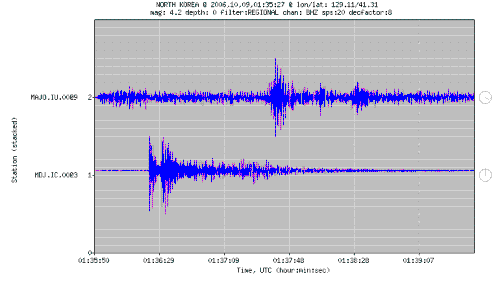
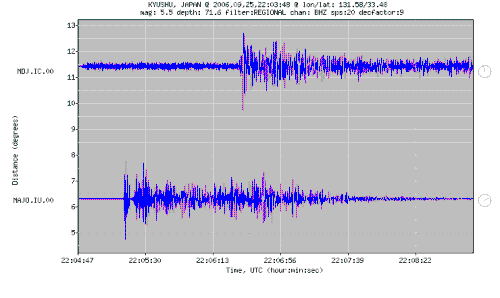
P waves are faster than S-waves, so will be the first to reach the station. It seems that for the North Korea event, a lot of the seismic energy received is in the first 10-15 seconds, and the signal dies out quite quickly after that. In contrast, the signal for the Japanese earthquake is received for more than 2 minutes, and the first peak is much less pronounced, suggesting that more energy is arriving in the form of slower S waves, and significant (above background) vibrations are received for a much longer period.
So, it seems likely that this is indeed an explosion, although that says nothing about whether the device actually worked; that would depend on knowing what the intended yield was, and even then it’s tricky, because not all of the energy released will be converted to seismic waves. This uncertainty may be behind the large discrepencies between the various estimates of the size of the explosion reported by New Scientist (see also the discussion at No Se Nada), which has led to speculation that the bomb might have ‘fizzled’. For what it’s worth, one of the textbooks on my desk says that a Hiroshima-size device (10-15 kT TNT equivalent) should generate a magnitude 5 quake, so if it didn’t fizzle, it seems to have been quite a small nuke.
18 July, 2006
Energy review says nothing much
Oooh, the government must be afraid of me. Why else would they choose to wait until I was away to release their new, improved energy review? Get the full details here. I neither have the time or the inclination to wade in detail through its entire 218 pages, but I have done more than skim through the executive summary; and, in contrast to the OTT pro-nuclear rumblings being put about by certain people, it does at least have some semblance of balance. In fact, contrary to the ‘back with a vengeance’ rhetoric, I find it a bit wishy-washy and non-committal. For example, the heavily-leaked nuclear stuff: as has been widely expected, the review concludes we need to build some new nuclear power stations, but doesn’t seem anywhere to suggest how many it thinks we might need. This might be why:
It will be for the private sector to initiate, fund, construct and operate new nuclear plants and to cover the full cost of decommissioning and their full share of long-term waste management costs.
Nothing to do with us, high gas prices will mean the private sector will be queuing up, no public money needed, oh no! Whether you think more nuclear is a good idea or not, I think we can all agree that this at best disingenuous. Decommissioning and waste storage issues are also somewhat glossed over (although to be fair, this is no change from the last 60 years or so).
One pleasant surprise is that there’s a whole chapter devoted to distributed energy generation and CHP which is actually reasonably positive, highlighting the potential benefits (which I’ve discussed before) as well as discussing potential downsides (possible loss of economies of scale, problems with fully exploiting offshore wind and other renewable resources). In the end, however, there is a disappointing, but predictable, commitment to not very much at all in this area:
To understand its true long-term potential, and the challenges we face in getting there, we will commission a high-powered investigation of the potential of distributed energy as a long-term alternative or supplement to centralised generation, looking at the full range of scientific, technical, economic and behavioural issues.
In a similar way, domestic energy usage and transport are referred to, but not in a way that lends confidence that the government is going to provide much in the way of leadership in these important areas. Even the warm and pleasing tones about renewables obligations are slightly marred by the fact that whilst wind is mentioned a fair amount (116 times in all compared to 441 for nuclear) solar and tidal energy get hardly a mention (17 and 11 times respectively).
It’s hard (especially in the current heatwave) to get really mad about something so fundamentally unambitious. Climate Change Action summarises some disappointed reactions from the likes of the Sustainable Development Commission and the Tyndall centre (pdf).
17 May, 2006
Pre-empting your own whitewash
I'm having real trouble understanding Tony Blair's speech to the CBI last night, where he declared nuclear power was 'back on the agenda with a vengeance'. The pro-nuclear spin is hardly surprising given the noises coming from the government lately, but given that the soon-to-be-published Energy Review was already expected to recommend building new nuclear power stations, why so publicly confirm the suspicion that the conclusion was preordained from the start? Surely this is not the best way to convince people.
I have two theories on this: one is that this is all a big softening up exercise, where the government threatens to build 50 (just a number pulled out the air) new nuclear power stations and exploits the sigh of relief when they then decide to build 10 or so as part of an integrated switch over to more sustainable energy sources. The other is that Blair has got to the stage where he thinks that any massively unpopular decision is the brave and right thing to do, regardless of logical or rational arguments to the contrary. Thus we'll all hate him but he'll be vindicated in the history textbooks of the future (which is where he always seems to be looking).
I'm fervently hoping for the former, but the fact that before the speech a Downing St spokesman rather disparagingly predicted "despairing shrieks of outrage" strongly suggests that the latter may be much closer to the truth. Which is a shame - I'm not going to deny that I'm rather unconvinced about the potential for nuclear to solve any of our environmental or energy security problems, but I'm in full agreement with David Osler, who actually does favour it but concludes:
But none of that should preclude a rational debate on the pros and cons of nuclear power. It's just a shame Blair is trying to bounce a reluctant populace into accepting a given outcome in advance.
Hear hear.
07 March, 2006
Look! Important people agree with me!
The BBC reports that the Centre for Sustainable Development - the Government’s own independent watchdog – has reported that, as I have been arguing, nuclear power is not the magic bullet for our energy woes.
From the SDC press release:
Based on eight new research papers (which you can read for yourself here), the SDC report gives a balanced examination of the pros and cons of nuclear power. Its research recognizes that nuclear is a low carbon technology, with an impressive safety record in the UK. Nuclear could generate large quantities of electricity, contribute to stabilising CO2 emissions and add to the diversity of the UK’s energy supply.
However, the research establishes that even if the UK’s existing nuclear capacity was doubled, it would only give an 8% cut on CO2 emissions by 2035 (and nothing before 2010). This must be set against the risks.
The report identifies five major disadvantages to nuclear power:
- Long-term waste – no long term solutions are yet available, let alone acceptable to the general public; it is impossible to guarantee safety over the long- term disposal of waste.
- Cost – the economics of nuclear new-build are highly uncertain. There is little, if any, justification for public subsidy, but if estimated costs escalate, there’s a clear risk that the taxpayer will be have to pick up the tab.
- Inflexibility – nuclear would lock the UK into a centralised distribution system for the next 50 years, at exactly the time when opportunities for microgeneration and local distribution network are stronger than ever.
- Undermining energy efficiency – a new nuclear programme would give out the wrong signal to consumers and businesses, implying that a major technological fix is all that’s required, weakening the urgent action needed on energy efficiency.
- International security – if the UK brings forward a new nuclear power programme, we cannot deny other countries the same technology (under the terms of the Framework Convention on Climate Change). With lower safety standards, they run higher risks of accidents, radiation exposure, proliferation and terrorist attacks.
On balance, the SDC finds that these problems outweigh the advantages of nuclear. However, the SDC does not rule out further research into new nuclear technologies and pursuing answers to the waste problem, as future technological developments may justify a re-examination of the issue.
The chairman of the SDC, Jonathon Porritt, had some strong words to accompany the report:
“Instead of hurtling along to a pre-judged conclusion (which many fear the Government is intent on doing), we must look to the evidence. There’s little point in denying that nuclear power has benefits, but in our view, these are outweighed by serious disadvantages. The Government is going to have to stop looking for an easy fix to our climate change and energy crises – there simply isn’t one.”
Of course, this is only one of many commissions and think-tanks likely to weigh into this debate in the coming months – and it’s not exactly a huge shock that a body concerned with sustainable development views nuclear energy with a somewhat sceptical eye. But it’s cheering to find my concerns being advocated by people the Government can less easily ignore. Which isn’t to say that they won’t, of course…
27 February, 2006
Government warms up its argument for nuclear power
Since I last talked about UK energy policy, the government has released a consultation document (available here) entitled 'Our Energy Challenge - Securing clean, affordable energy for the long-term'. It weighs in at 77 pages, mainly because it spends much of it’s time repeating itself, but offers a good insight into the argument the government is likely to be making as it tries to convince us that nuclear power is the one, true way.
The report, starts off by reiterating the goals laid out in the 2003 Energy White Paper 'Our energy future – creating a low carbon economy':
With reference to the first goal, the report is quick to boast that “The UK remains one of the few European countries on track to meet its Kyoto commitment to address climate change”; however, it also presents figures which should severely curtail any smug laurel resting. Between 1991 and 2000 there was a relatively steady drop in CO2 emissions from 210-180 Mt/yr, due to the switch from coal- to gas-fired electricity generation in the 1990s. Since 2000, however, emissions have remained relatively flat (although still below our Kyoto target of 12.5% below 1990 emissions levels).
To make things even worse, emissions are currently projected to stay at similar levels out to 2020, which can hardly be described as ‘real progress’. There are several causes for this current and projected stasis:
This situation is not just worrying from an environmental perspective. The increased reliance on gas at a stage when our own reserves in the North Sea are starting to wane also raises concerns in the ‘energy security’ arena, because we’d be relying on overseas suppliers (mainly Russia, the Middle East and Africa) to supply most (possibly 90% by 2020) of the fuel for our power stations as well as the domestic heating market, which also primarily uses gas. Economically, this is a compromising position to be in.
These facts combine to produce what will undoubtedly be the government line following the ‘consultation’. If we are to cut emissions, and if we are to enjoy more energy security, we want to avoid moving to such a heavy reliance on gas in the next two decades. Reducing energy usage is impractical, so we need to change how that energy is generated. Renewables can’t cut it (contrast the 20 GW shortfall predicted for 2020 with the 500MW of renewable wind capacity added to the National Grid last year). Nuclear is proven technology, cuts emissions and means that we are not hostage to the whims of overseas suppliers. To reduce emissions further we can combine this with carbon sequestration – pumping our CO2 into empty oil and gas reservoirs rather than releasing it into the atmosphere.
Well, it’s a strategy. But, as I’ll try to show in my next post, it’s a pretty stupid one.
28 November, 2005
Fission back in fashion?
The nuclear debate has reared its ugly head again, with Our Glorious Leader apparently 'convinced' (which sounds awfully familiar; does he never learn?) that we must turn to nuclear power to meet emissions targets and ensure energy security.
My views on the nuclear question are complex. I'm aware of the disadvantages, of course: the production of long-lived, highly radioactive waste products (and, more importantly, still no clue about how to provide safe long-term storage for them), the reliance on expensive technology which is difficult to maintain and dismantle, and the horrific consequences if something goes wrong. There are, however, potential benefits: the cuts in CO2 emissions resulting from less use of fossil fuels, and the reduced dependence on diminishing supplies of oil and gas, most of which comes from areas of questionable political stability (and that's before we stick our oar in). So the question is, do these benefits outweigh the risks?
When this first hit the news last week, I took what I thought to be a pragmatic 'lesser of two evils' line: it's not ideal, and in a perfect world we wouldn't touch nuclear fission with a barge pole, but given the likely gap between our energy use and that which is probably going to be supplied by renewables (in the near future at least), if we're serious about cutting greenhouse gas emissions then we might well have to consider it.
Then I read this op-ed by Magnus Linklater in The Times, which is mainly based on the work of Jan Willem Storm van Leeuwen and Philip Bartlett Smith. Unfortunately, I can't find any of their stuff on-line as a primary source, but their biographies (pdf) indicate that you can't just write them off has raving eco-hippies; they have both spent large parts of their careers involved with the nuclear industry.
According to Linklater:
What they have done is look at the entire life cycle of a nuclear power station, from the mining of the uranium to the storage of the resulting nuclear waste. Their conclusions make grim reading for any nuclear advocate.
They say that at the present rate of use, worldwide supplies of rich uranium ore will soon become exhausted, perhaps within the next decade. Nuclear power stations of the future will have to reply on second-grade ore, which requires huge amounts of conventional energy to refine it. For each tonne of poor-quality uranium, some 5,000 tonnes of granite that contains it will have to be mined, milled and then disposed of. This could rise to 10,000 tonnes if the quality deteriorates further. At some point, and it could happen soon, the nuclear industry will be emitting as much carbon dioxide from mining and treating its ore as it saves from the 'clean'” power it produces thanks to nuclear fission.
And that's before you've even considered the enrichment stage, where you separate U-238 from the non-fissile U-235, which also requires energy. We will of course meet this point even sooner if a new generation of reactors increases the global appetite for enriched uranium; after which the CO2 emissions 'saved' by nuclear electricity generation will be insufficient to offset that used to produce the fuel for it. Worse still, as demand for uranium ore increases, where will it all come from?
Not friendly Canada, which produces most of it at present, but places like Kazakhstan, hardly the most stable of democracies. So much for 'secure'” sources of energy. We would find ourselves out of the oil-producing frying pan, right in the middle of the ore-manufacturing fire.
Hmmm...suddenly I'm not so sure about that cost-benefit ratio. Especially when you consider that electricity generation as a whole only accounts for about a quarter of the total UK energy usage - getting on for 50% of the fossil fuels we burn are presently consumed by transport and domestic gas (The DTI provides some only slightly impenetrable figures here). Switching some gas-power stations off and replacing them with nuclear isn't going to affect those sectors at all.
So, could nuclear be an intermediate option in a long-term strategy - buying us time to switch over to more sustainable energy sources and usage? Possibly, but building nuclear power stations is a long and drawn out process (even the optimistic projections of proponents seem to reckon if we started right now it would be at least 10 years before we could add new nuclear capacity to the National Grid. And the cost will be fearsome. I wonder what you could do if you invested those billions in renewables (still scandalously cash-starved despite the high-minded rhetoric)? Or used it to every house in Britain loft insulation and solar heating systems?
I won't deny I have environmental sympathies, but I'm willing to be convinced that nuclear has a role in providing for our future energy needs. But I do have severe doubts which I'd like to be addressed. In detail. Unfortunately, if you'll forgive my cynicism, I have a feeling that this 'debate' which is currently being called for might well consist of 'this is right, anyone who disagrees is out of touch with the issues'. Don't know where I could have got that idea from...