
25 January, 2006

What, no polar bears?

A couple of weeks ago, I discussed Bryden et al.'s widely reported Nature paper, which claimed a significant slowdown in the thermohaline circulation, and suggested that we're going to have to wait to see whether the results reflect a real trend, or are just a combination of error and natural variability in a poorly described system. All very well, but then I concluded:

In a couple of years, maybe we'll know whether I'll retire to vineyards or polar bears in my back garden.
Flippant, perhaps, and as it turns out also rather foolish. Via Real Climate, I've just come across a nice discussion (subscription required, I'm afraid) of how, even if the conveyor is slowing, its impact is not quite as simple as on=vineyards, off=polar bears.

One interesting aspect of this article is the caution with which most climate scientists are treating these results. Some example comments:

  • "The story is appealing, but it is a very extreme interpretation of the data."
  • "Bryden's results are extraordinary, but this is exactly why they require extraordinary evidence."

If nothing else, this shows exactly how slanderous so-called 'critics' are being when they accuse climate scientists of being more interested in playing politics than objective scientific analysis. If all they were interested in was scaring people into their liberal, social-engineered worldview and securing research funding, such data is an open goal for spinning any number of apocalyptic scenarios, a la James Lovelock. Instead, they are quite open about their doubts, which stem from two main sources. The first is observational: a reduced thermohaline circulation should reduce heat transport into the North Atlantic, but there has been no drop in high latitude sea surface temperatures, and Europe has been warming, not cooling, in the last decade. Secondly, the estimated increase in fresh water added to the surface North Atlantic is lower, by an order of magnitude, than that required by modelling to stop NADW formation. Much more warming is required before the thermohaline circulation should be seriously affected.

But going back to the quote from my previous post, the other message from this article is that although reduced NADW formation can be linked to cooling of Europe in the past, it is by no means clear that a shutdown will also lead to cooling in the future, and in fact most modelling seems to indicate it will not. At the end of the last Ice Age many think that the presence of sea ice provided an important positive feedback (through both the familiar ice-albedo effect, and by preventing heat transfer between ocean and atmosphere) which exacerbated cooling in response to slowing of the thermohaline circulation; our present warming climate reduces sea ice cover and hence the effectiveness of this mechanism. As Wally Broecker, one of the pioneers of this whole idea, puts it:
"The notion that a collapse of the thermohaline circulation may trigger a mini ice age is a myth."
But even if the local effects we might have expected may not be on the cards, this does not mean that we should not be concerned: the thermohaline circulation also plays an important role in supplying nutrient rich bottom water to many parts of the world, and additionally enhances the ability of the oceans to absorb CO2 from the atmosphere (by transferring dissolved CO2-rich water to the deep ocean). A shutdown could still have serious consequences. But, whatever happens, it appears that my garden will remain polar bear free.

Newer developments:
The Case of the THC "Shutdown"
THC not as weak as we thought - most of the time

19 January, 2006

We're all dooooomed!

On Monday, James Lovelock, the originator of the Gaia concept, published this article in The Independent, in which he gives a rather gloomy diagnosis of the planet’s health:

The climate centres around the world, which are the equivalent of the pathology lab of a hospital, have reported the Earth's physical condition, and the climate specialists see it as seriously ill, and soon to pass into a morbid fever that may last as long as 100,000 years. I have to tell you, as members of the Earth's family and an intimate part of it, that you and especially civilisation are in grave danger…

…before this century is over billions of us will die and the few breeding pairs of people that survive will be in the Arctic where the climate remains tolerable.

These levels of doom-mongering are unfortunately far too easily caricatured as a typical outburst from the sandal-wearing eco-evangelist set, and unlikely to be taken that seriously by anyone who isn’t worried already. Which is a shame, because this article contains the kernel of a point which I think should be hammered home to those who refuse to take our effect on the planet seriously at every opportunity: we need to spend much more time talking about the fragility of human civilisation in the face of rapid climate change. Whose crops fail when rainfall patterns are altered? Whose cities are flooded when sea-levels rise, or flattened by increasingly severe storms? Whatever damage we’re doing to the rest of the planet, our own house is also tottering on increasingly rotten foundations.

You might be surprised to learn that I’m not particularly worried about the long-term health of the planet, but that’s because I’m using long-term in the geological sense, and palaeontology teaches us that life as a whole can endure and bounce back from even extreme calamities. However, it also teaches us that change is the key to this recovery – new species supplant the old, and despite our technological prowess there’s no guarantee that we can buck that trend. In 50 million years, if Lovelock’s fears are realised, the planet might be host to another sentient species, who will puzzle over the apparently self-inflicted extinction of a tool-using, hairless race of primates which clearly had ideas above its station. They’ll probably also curse us for burning all the oil.

The obstacles to healing Gaia’s fever lie not in means, but in motive, in finding the will to possibly compromise our short-term comfort for a long-term goal. Sadly, this is not a defining characteristic of our species, as Lovelock discusses in his own hyperbolic way:

…sadly I cannot see the United States or the emerging economies of China and India cutting back in time, and they are the main source of emissions. The worst will happen and survivors will have to adapt to a hell of a climate.

To the cynic, the reasons for the pessimism become clear when we are informed that Lovelock has written a whole new book, ‘The Revenge of Gaia’. Ah-ha. Interestingly, if the synopsis if accurate, this expands his opinion from ‘We’re all dooooomed!’, to “We’re all doooomed! Unless you do what I say!” Even he thinks we have some hope, he’s just suppressing it for promotional purposes (in fairness to The Independent, they do let someone else argue that the problem is not yet insoluable).

Self-interest is a powerful force if we can harness it, trumping altruism every time. As more people realise that it’s not just the whales and rainforests which are at stake, but their own necks, they are more likely to start worrying, and forcing the hand of our spineless leaders.

16 January, 2006

Stardust doesn't crash

The capsule from the Stardust probe, carrying particles collected from the halo of Comet Wild-2, has landed intact in the the Utah desert. This must have come as a bit of a relief for the scientists involved after what happened to the similar Genesis mission, which returned solar wind particles to Earth in 2004 with a much bigger bump than expected, because the deceleration sensors which were meant to trigger the parachutes were put in backwards (it seems, incidentally, that not all has been lost from that mission).

So why the obsession with chasing dust? It's all to do with trying to work out how the solar system formed 4.6 billion years ago, a process which is still poorly understood. We have a general theory: a cloud of interstellar gas began collapsing under its own gravity into a solar nebula, triggered by a nearby supernova or other disturbance. This collapse heated up the centre of the nebula enough the trigger nuclear fusion, forming the Sun. Meanwhile, material in the cooler outer parts of the nebula condensed and coalesced into small protoplanets, which through numerous collisions eventually formed the larger planets we see today. Knowing the end result - small rocky planets closer to the sun, icy gas giants further out - provides important constraints on how this process occurred, but not enough to really understand what happened. You can produce several quite different models which give similar end results, mainly because we have to guess our starting conditions - the initial composition of the solar nebula is poorly known, and which model works best in producing a familiar solar system depends on which initial composition you assume.

This is where Comet Wild-2 (pronounced "Vilt-2", which I personally think makes it sound far less exciting) comes in. Comets are left over bits of material from the outer parts of the solar nebula, which were too far away from each other to coalesce into anything bigger; their composition is therefore likely to be very close to that of the original nebula itself, because only in large bodies can mixing and differentiation of elements (such as in the Earth, where heavy elements such as iron have been concentrated in the core) occur. Wild-2 has spent most of it's life in the outer reaches, meaning that has been kept in pristine condition; only recently, when a close encounter with Jupiter in 1974 slung it into the inner solar system, has the sun been close enough to start boiling off its volatile materials. This change in orbit also placed it within much easier reach of Earth, making a mission to return samples of material unaltered since the birth of the solar system possible (for the curious, in the case of Genesis, the outer layers of the sun from which the solar wind originates are also thought to contain material which is as yet unaltered by nuclear fusion from its initial state).

As well as constraining our models of planetary formation, knowing the composition of the early solar nebula can also answer other important questions. One thing scientists want to know is, is our sort of solar system commom, or rare? Almost all of the extra-solar planets we know about are gas giants orbiting their stars closer than Mercury does. Is this due to present limitations with detection techniques (after all, it was less than 10 years ago that no-one could say for sure that there were any extra-solar planets), or is our home system a weird aberration? By comparing our own solar nebula to other planet-forming nebula (for example, in the Orion Nebula), we might get some clues. Additionally, people will be looking for the presence (or not) of organic molecules, which may indicate that collisions with comets billions of years ago may have provided the raw materials for the emergence of life on Earth.

10 January, 2006

Richard Dawkins' The Root of All Evil?

You have to love Channel 4. On the one hand, this is the channel that is currently bringing us Celebrity Only (But In Their Own Minds) Big Brother, and is responsible for Space Cadets, the current low water mark for 'reality' (or 'make the proles look stupid') TV. But then last night it gave Richard Dawkins, the atheist Christians love to hate, the first of two prime-time slots to put forth his...erm...passionate views on religion (go here for the Channel 4 blurb). Now that's diversity.

I must admit straight away that I like Richard Dawkins. His writings about evolutionary biology are models of clarity, and in his more general writings on science he articulates an awe and wonder at the Universe revealed by science makes you realise that he is a long way from the nihilistic caricature often called up by his opponents. However, he makes no secret of his disdain for religion, and his use of his position in the public consciousness to make negative pronouncements on 'the process of non-thinking called faith' have earned him censure even from those who have sympathy for his views. But let's face it, religious bigotry is hardly soley the purview of the atheist; indeed, to paraphrase one of Dawkins' more famous quotes (which he used himself in the programme last night), we are all condescending and bigoted about most of the religions that humanity has ever believed in; he just goes one religion further.

That said, I'm not really sure what this program was trying to achieve. The actual scientific content was quite thin (what was there was well-explained), and as a meditation on why people reject reality in favour of ancient holy texts it wasn't particularly illuminating either. This was, I feel, the fault of both the interviewer and also the choice of interviewees. Dawkins was disinclined or unable to conceal his distaste for the views of those he was talking to - I suspect the former, because he also made several statements which were bound to inflame the discussion. For example, when talking with the Ted Haggard, president of the National Association of Evangelicals, he told him,'I was impressed by your show, it reminded me very much of...' paused, waited for everyone to mentally fill in '...rock concert', then finished '...the Nuremberg rallies'. Not likely to go down well. And it's really not much of a revelation that Haggard is not a great believer in the scientific method - I'm more interested in the why. Because this stuff is not restricted to the American Bible Belt; I personally know many evangelical Christians, both in the UK and abroad, who are surprisingly (and disturbingly) sympathetic to notions of Biblical literalism, and who are therefore rather uncomfortable when I talk about things geological. Why do they reject the majestic, strange and mind-blowing cosmos revealed by science, far more worthy of their God, in favour of the limited and petulant deity perceived by our ancestors? I don't think you're not likely to gain much insight into this question when you compare your subject to the Nazis (the interview with Haggard did, however, provide the most entertaining moment in the whole hour, when he said that he knew scientists 'who did not believe that structures like the eye and the ear could ever have arisen by accident'. Dawkins' own eyes almost exploded in the face of this misrepresentation of evolutionary theory).

Trawling the blogosphere for other posts which discussed this programme, two stand out. There's a much fuller review than I have time for at leyton.org; and A Very British Dude points out that Dawkins, rather oddly perhaps, omitted to talk about how the religious 'meme' from an evolutionary perspective (it might, for example, confer some advantage in terms of creating united, expansionist societies). I wonder whether Dawkins' second programme, unprovocatively entitled 'The Virus of Faith', might talk about that. Dude's conclusion is a bit dystopic for my taste, but it's well worth a read.

08 January, 2006

What does 'Highly Allochthonous' mean?

There are two different answers to this question, the first of which is the technical one. An allochton is a chunk of landscape which has been superimposed by faulting on top of rocks representing a completely different depositional environment; for example, a sequence of deep marine sediments which has been thrust over shallow marine or continental deposits. Therefore, a 'highly allochthonous' sequence is one that has been transported a large distance, usually by thrust faulting (I want to put a graphic in the title bar which expresses this concept, and who knows, maybe I'll actually get round to it at some point).

The second answer (which I know doesn't really flow from the question except in a highly tenuous way - deal with it) is the 'so what's this blog all about then?' one. I could tell you that the name 'poetically reflects my aspirations to cover the vast diaspora of disciplines which make up Earth Sciences', but in truth it's just a cool phrase which formed part of the banter when I was a geology undergrad, and it just seemed appropriate. On balance, I think the geeky true answer is preferable to the poncy false answer. Probably.

As for why I'm doing this - well, I like writing and I like science (my interest just about surviving exposure to the National Curriculum), so I've always been interested in science communication. More recently, as my PhD submission loomed, I've been looking for jobs in that sort of area, but with very little success. So, inspired by some of the excellent science blogs out there, and the fact that Geology appears to be a little underepresented in the blogosphere (from my searching thus far,at least), I thought this would be a good way to practice and develop my writing. It's good for me scientifically too, forcing me to read more widely that I might otherwise; for example, whilst writing my last post, I had to learn about aspects of oceanography I hadn't really covered in detail before. And I'm sure my teaching can only be improved by thinking more about ways to explain technical details of my subject more accessibly. Perhaps fortunately, none of these things specifically require my outpourings to be read! If people do visit and get something from my postings, that will just be a nice bonus (and of course is the thing that I hope for deep in my heart).

I started this blog in a blaze of enthusiasm last September, and realised quite quickly that producing regular posts was not quite as easy as I thought it would be. My so-called 'technical' job has involved a lot of teaching and other tasks strangely reminiscent of an academic position, on top of running the paleomagnetic laboratory and processing data for people. This has given me little enough time to do anything about my own research, so finding the time to write for this blog when I actually felt like writing has proven tricky. And writing each post seems to take much longer than I expect it to, although I'm hoping to get faster with more practice. I'm probably not helped by the fact that for the most part I don't really see the point of posting short links to news stories published elsewhere without adding my own analysis of my own. I'm not sure that will change, but I am hoping to post more regularly than the monthly spurts I've managed up to now. As for sustaining it - well, I have several ideas for posts stored in my brain (and even occasionally partially begun on my laptop), and more seem to pop up all the time, so it bodes well, or ill, depending on your perspective!

The Decade After Tomorrow?

Authors note: This post was mostly written before Christmas, but I then got distracted and didn't get the chance to finish it. I guess it's a bit less topical now but I don't like to waste hard-written words...

What does the the paper published in Nature last month by Bryden et al.[1] have in common with a recent Hollywood disaster movie? Answer: before The Day After Tomorrow descended into 3000km-wide superstorms sucking down air from the stratosphere and turning everybody into icicles (casually breaking the laws of thermodynamics in the process), both are concerned with a possible weakening of the thermohaline circulation in response to climate change.

However much we moan about the weather here in the UK, we should bear in mind that we are located roughly as far north as Hudson Bay. Which, it could be argued, is a tad cooler than here. The reason for this is that we (and the rest of Western Europe) benefit from the Gulf Stream, a strong current of warm surface water that flows from the Gulf of Mexico to the northeast Atlantic, bringing a lot of heat from the tropics with it. A large part of this north-eastward flow is wind-driven, but not all of it is. In the current climate system, heat loss and evaporation causes seawater in the northern Atlantic, particularly in the Nordic and Labrador Seas, to become so cold and salty, and therefore dense, that it sinks into the deep ocean and moves south back towards the equator below the surface currents, at depths of several thousand metres. About 20-30% of the total northward flow of water in the Gulf Stream is moving to replace the downwelling water in the North Atlantic as part of this 'thermohaline circulation'; the additional heat transfer from equatorial regions, and the penetration of warm water to much higher latitudes than would result from wind-driven flow alone, combine to produce much higher seasonal temperatures on our side of the Atlantic.

Looking back into the past, we can see a link between the strength of the thermohaline circulation and high latitude temperatures in the Northern Hemisphere. The sinking water in the Nordic and Labrador seas - often referred to as the North Atlantic Deep Water (NADW) has chemical properties which make it distinct from, for example, water from the oceans around Antarctica, or the Pacific. By taking sediment cores from the South Atlantic and chemically analysing shells or minerals that formed in ancient seas thousands of years ago, the penetration of the NADW into this region, which is greater when the thermohaline circulation is stronger, can be estimated (e.g. [2]). Such studies show that at the end of the last Ice Age, about 19,000 years ago, when glaciers covered much of northern Europe, the thermohaline circulation was much weaker than today, and strengthened over the next 10,000 years as we moved into the present (warm) Holocene period. More significantly, the sediment cores also indicate rapid oscillations in the penetration of NADW, where the thermohaline circulation suddenly got much stronger or weaker - oscillations which can be correlated to abrupt warming or cooling events in the northern hemisphere. These variations apparently occurred over very short timescales - certainly not three days, as a certain movie would have you believe, but in the course of decades, still extremely fast by geological standards.

The current warming trend is making surface waters in the North Atlantic less saline (and therefore less dense) by adding large amounts of fresh water - for example, from the melting of the Greenland icecap. This can potentially reduce NADW formation by weakening downwelling. Models of the thermohaline circulation suggest that once enough meltwater is added, the circulation abruptly collapses into a much weaker current. Furthermore, this change is not reversible - the density of surface waters has to increase substantially before vigorous NADW formation restarts.

Whilst this is all very worrying, up until now there has been no real indication that the increased supply of meltwater to the North Atlantic has been having the predicted effect. Now, however, Bryden et al. report the results of the latest of a series of east-west transects (starting in 1957, with the most recent in 1998 and 2004), measuring variations of water temperature and salinity with depth at various points, across the Atlantic Ocean at 25 degrees North. These measurements can be used to calculate the 'geostrophic flow': Coriolis forces caused by the Earth's rotation mean that north- or south- flowing currents in the Atlantic oceans generate east-west pressure gradients, which can be calculated from the temperature and salinity profiles (in case that made no sense whatsoever - not unlikely - this post at realclimate.org is a good starting point). Compared to the previous transects, results from the latest one in 2004 appear to show a 50% reduction in the southward flow of water between 3000 and 5000 m depth, which is sourced from downwelling water in the Norwegian Sea.

However, before you start investing wholesale in your uncle's woolly hat company, it's worth reading the small print. Because the current strengths are being estimated by an indirect method, the potential errors are quite large; in fact, the authors estimate that the error is about the same size as the apparent decrease in NADW flow. They also argue that because the observed reduction is associated with a particular component of the flow, rather than distributed at all levels, the effect is real, which is a fair point but not a conclusive one. The other problem is that there is virtually no data on the natural variability of the thermohaline circulation, so it is also possible that the most recent survey is just detecting this rather than a sustained reduction.

These caveats make it hard to really assess the significance of these results. But watch this space - the cruise which collected the data for this study was part of a programme to deploy a series of buoys along the 25N transect, which will continuously monitor the thermohaline circulation. This system will give a much better idea of the seasonal variability of the thermohaline circulation, and also reduce the errors in estimates of its strength. In a couple of years, maybe we'll know whether I'll retire to vineyards or polar bears in my back garden.

Newer developments:
The Case of the THC "Shutdown"
THC not as weak as we thought - most of the time
What, no polar bears?


[1] Bryden et al (2005). Nature 381, p655-657.
[2] Piotrowski et al. (2004). Earth and Planetary Science Letters 225, p205-220.

01 December, 2005

More probing

Typical, really; no sooner do I put up this post about how we're going to have to wait a bit before Mars Express starts searching for water, than ESA goes and announces that it's found some.

Well, maybe. What they have found is a buried impact crater beneath the surface of Chryse Planitia, a fairly flat area in the northern equatorial region of Mars (it's in the centre of the map here).

These data are from some of the very first observations made by the MARSIS radar, when it was still approaching close to the planet at night. The image below shows the results of two different passes, separated by about 50 km, over the same region in Chryse Planitia. Note that the vertical axis does not measure depth but time: it is measuring the delay between the radar pulse being sent out and reflected radio waves being recieved back at the source (so the further down the screen it is, the more time has elapsed).


When the radar pulse encounters a boundary between substances with different physical properties, some of its energy is reflected back up to the orbiter; these boundaries show up as bright finges on the plot above. The first reflector is obviously the surface (which reflects a lot of energy due to the large contrast between Martian air and Martian rock) but some energy is clearly making into the subsurface. In both plots you can see a number of curved reflectors; these could represent a series of impact basins, although they look a little to me like multiple reflections (where upward reflected energy bounces around between the buried reflector and the surface one or more times before escaping). There is no sign of this structure on the surface, so it has clearly been filled with rock debris since it formed.

What's causing the excitement is the horizontal reflecting horizon seen in the second profile (at about 25 microseconds, which is about 2km, below the surface). One possibility is that this represents the upper boundary of a layer of water- or ice-rich material filling in the bottom of the crater. It's not the only possibility, but it does make some sense: Chryse Planitia is a relatively low area at the bottom end of a number of outflow channels, including those from Valles Marineris, which show evidence of water erosion.

So, interesting, but not conclusive, perhaps. Still, it bodes well for the future. I like this quote from New Scientist:

The most exciting part of this experiment is simply "that it works", says MARSIS co-leader Jeff Plaut of NASA's Jet Propulsion Laboratory in Pasadena, California, US.

It seems that no-one was sure if this thing would actually work. Interesting how that only comes out now that they've seen it does...

30 November, 2005

Lava lake tectonics

Part of the duties of my new job is some lecturing on behalf of my supervisor (now boss, I suppose). I'm finding this a bit daunting, even if I have been given Powerpoint presentations for each lecture; this means at least I don't have to compile things from scratch, although it does take a while to remove all the instances of text zooming in with a swooshing sound (another crime against humanity perpetrated by Microsoft).

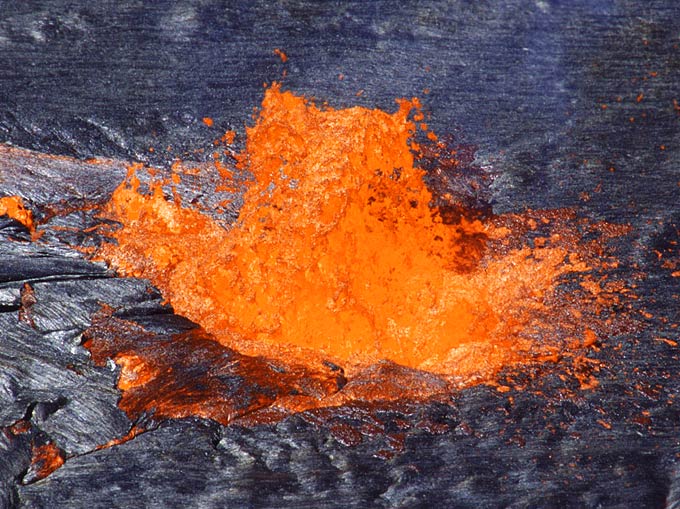
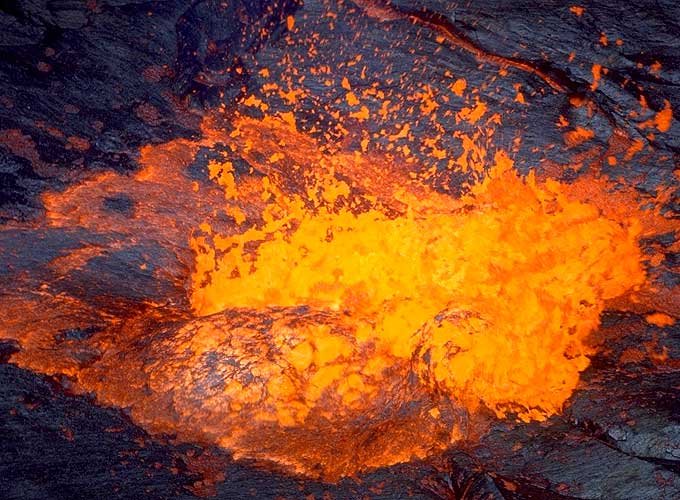
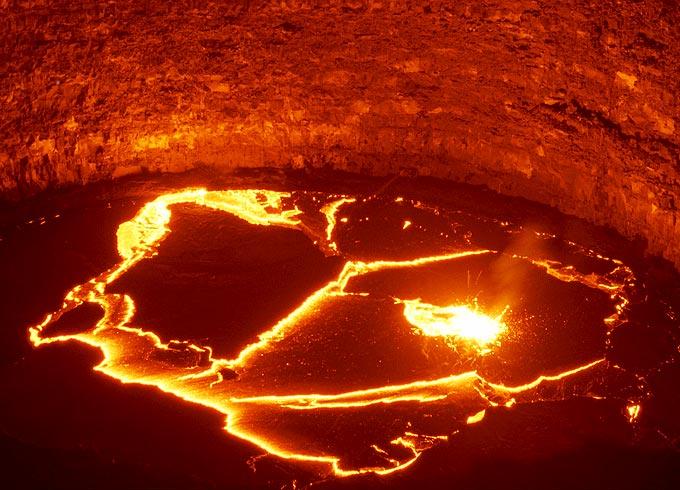
My first lecture started with a discussion of why we have tectonic plates, and I got to present a really cool example of a situation where similar processes are occurring over timescales much easier for us to grasp conceptually. All the pictures in this post come from a lava lake in the crater of Erte Arle volcano in Ethiopia. You get lots of the sorts of activity you’d associate with such an environment (such as fountain eruptions and bubbling molten lava), all occurring as the lava is heated from below and the hotter, less dense, material forces its way to the surface. However, what's even more interesting is that a lot of the time the surface of the lake is formed by a solid crust of cooled magma. Vigorous convection is still occurring beneath this crust, and in response to this the crust breaks up into a number of discrete slabs.


Sound familiar? The relationship between the lava crust and the convecting molten lava beneath it is precisely the same as that between the lithosphere and the asthenosphere - the convecting and non-convecting parts of the Earth's mantle. In both cases the boundary is controlled not by composition but by temperature - contact with the air has cooled the upper part of the lava lake so that it solidifies and begins to act rigidly; heat loss through the Earth's surface causes the same thing to happen to the upper 100 km or so of the mantle.

The internal strength of the lava 'plates' compared to the molten material beneath them causes them to move coherently over the surface of the crater, with little frictional drag at their base to slow them down, or dissipate any forces which are applied to them. In such a situation the forces exerted at the boundaries of the slabs become particularly important. Again, the same situation seems to apply for the tectonic plates on the Earth's surface, so it is no surprise that you can see analogues of different types of tectonic plate boundaries at the borders of the lava slabs. Here's a rift zone, where two slabs are moving apart:


The orange crack shows where lava is welling up to the surface of the lake. It cools and solidifies and is itself pushed away from the rift by yet more upwelling magma. Notice the symmetrical pattern of light and dark grey bands moving away from the crack - this is caused by slight variations in the composition of the upwelling magma over time (and is very reminiscent of the striped magnetic anomalies seen either side of a mid-ocean ridge).

The force pushing the slabs apart at this boundary will be transmitted to the opposite boundaries of the two slabs, where they will be pushed against their neighbours. In such a situation one plate is forced beneath the other, forming a 'subduction zone' (in the picture below, the lava slab is being pushed against the crater wall, but the principle remains the the same):


The best thing about this example, though, is that molten lava has a much lower viscosity than asthenospheric mantle, flowing at centimetres per second rather than centimetres per year. This means that you can see the equivalent of hundreds of millions of years of tectonic processes occurring in the space of a few hours. This movie (Quicktime) was created using time-lapse photography: as evening draws in, plates on the surface of the lava lake are created and die, move apart and push together. It's really cool. Watch it.

Probe update

Not as dodgy as it sounds, I promise!


  • Following a successful launch, ESA scientists have begun checking out the instruments on the Venus Express probe, by pointing them back at the Earth-Moon system and taking some pictures with the VIRTIS spectrometer. VIRTIS stands for 'Visible and Infrared Thermal Imaging Spectrometer' (it can apparently measure at ultraviolet wavelengths too but that would have mucked up the acronym...) and is designed to measure the composition of the lower atmosphere by measuring in spectral windows which are not blocked out by clouds in the upper atmosphere - according to this site you might also be able to make some surface measurements at near-infrared frequencies, which would be pretty cool.

    The probe is already 3.5 million kilometres away, so the data collected are not particularly ground-breaking, but they confirm that the instrument is in good shape for the real observations, starting when the probe enters Venus orbit in April next year, and are useful for calibration purposes.

  • The MARSIS radar on the Mars Express has now been operating for four months, as is summarised here. The orbiter has a highly eccentric orbit, and during most of the observation time so far the time of closest approach has been in the daytime. This means that the best measurements are being made when the upper atmosphere (ionosphere) is excited by solar radiation, making it more opaque to the lower radar frequencies required to penetrate the sub-surface. We're still getting lots of data about the structure of the Martian atmosphere and surface, but the real fun begins next month, when the closest approach will be at night; the search for underground water can then start in earnest. This delay in sub-surface measurements was not intentional, but a conseqeunce of the delay in deploying the radar booms last year. I'm glad the mission has been extended to compensate

  • Meanwhile, New Scientist reports that the Japanese Hayabusa probe, which managed to land on an asteroid and collect surface samples over the weekend (on the second attempt - on the first landing attempt last week the pellet gun designed to dislodge material from the surface of the asteroid failed to fire) is suffering from a thruster malfunction.
    Problems with the thrusters and control systems have plagued this mission from the start, so even if they get it working it's not clear if there's enough fuel to return the samples to Earth. Fingers crossed.

  • Finally, another in the seemingly non-ending stream of fabulous images from Cassini:


    This image of Enceladus is backlit by the Sun, and illuminates plumes of water vapour rising up from its south pole. The cause of this geological activity is not yet understood, but it's still pretty cool!

    A larger image can be found here,and an enhanced false colour image here.

28 November, 2005

Fission back in fashion?

The nuclear debate has reared its ugly head again, with Our Glorious Leader apparently 'convinced' (which sounds awfully familiar; does he never learn?) that we must turn to nuclear power to meet emissions targets and ensure energy security.

My views on the nuclear question are complex. I'm aware of the disadvantages, of course: the production of long-lived, highly radioactive waste products (and, more importantly, still no clue about how to provide safe long-term storage for them), the reliance on expensive technology which is difficult to maintain and dismantle, and the horrific consequences if something goes wrong. There are, however, potential benefits: the cuts in CO2 emissions resulting from less use of fossil fuels, and the reduced dependence on diminishing supplies of oil and gas, most of which comes from areas of questionable political stability (and that's before we stick our oar in). So the question is, do these benefits outweigh the risks?

When this first hit the news last week, I took what I thought to be a pragmatic 'lesser of two evils' line: it's not ideal, and in a perfect world we wouldn't touch nuclear fission with a barge pole, but given the likely gap between our energy use and that which is probably going to be supplied by renewables (in the near future at least), if we're serious about cutting greenhouse gas emissions then we might well have to consider it.

Then I read this op-ed by Magnus Linklater in The Times, which is mainly based on the work of Jan Willem Storm van Leeuwen and Philip Bartlett Smith. Unfortunately, I can't find any of their stuff on-line as a primary source, but their biographies (pdf) indicate that you can't just write them off has raving eco-hippies; they have both spent large parts of their careers involved with the nuclear industry.

According to Linklater:


What they have done is look at the entire life cycle of a nuclear power station, from the mining of the uranium to the storage of the resulting nuclear waste. Their conclusions make grim reading for any nuclear advocate.

They say that at the present rate of use, worldwide supplies of rich uranium ore will soon become exhausted, perhaps within the next decade. Nuclear power stations of the future will have to reply on second-grade ore, which requires huge amounts of conventional energy to refine it. For each tonne of poor-quality uranium, some 5,000 tonnes of granite that contains it will have to be mined, milled and then disposed of. This could rise to 10,000 tonnes if the quality deteriorates further. At some point, and it could happen soon, the nuclear industry will be emitting as much carbon dioxide from mining and treating its ore as it saves from the 'clean'” power it produces thanks to nuclear fission.


And that's before you've even considered the enrichment stage, where you separate U-238 from the non-fissile U-235, which also requires energy. We will of course meet this point even sooner if a new generation of reactors increases the global appetite for enriched uranium; after which the CO2 emissions 'saved' by nuclear electricity generation will be insufficient to offset that used to produce the fuel for it. Worse still, as demand for uranium ore increases, where will it all come from?

Not friendly Canada, which produces most of it at present, but places like Kazakhstan, hardly the most stable of democracies. So much for 'secure'” sources of energy. We would find ourselves out of the oil-producing frying pan, right in the middle of the ore-manufacturing fire.


Hmmm...suddenly I'm not so sure about that cost-benefit ratio. Especially when you consider that electricity generation as a whole only accounts for about a quarter of the total UK energy usage - getting on for 50% of the fossil fuels we burn are presently consumed by transport and domestic gas (The DTI provides some only slightly impenetrable figures here). Switching some gas-power stations off and replacing them with nuclear isn't going to affect those sectors at all.

So, could nuclear be an intermediate option in a long-term strategy - buying us time to switch over to more sustainable energy sources and usage? Possibly, but building nuclear power stations is a long and drawn out process (even the optimistic projections of proponents seem to reckon if we started right now it would be at least 10 years before we could add new nuclear capacity to the National Grid. And the cost will be fearsome. I wonder what you could do if you invested those billions in renewables (still scandalously cash-starved despite the high-minded rhetoric)? Or used it to every house in Britain loft insulation and solar heating systems?

I won't deny I have environmental sympathies, but I'm willing to be convinced that nuclear has a role in providing for our future energy needs. But I do have severe doubts which I'd like to be addressed. In detail. Unfortunately, if you'll forgive my cynicism, I have a feeling that this 'debate' which is currently being called for might well consist of 'this is right, anyone who disagrees is out of touch with the issues'. Don't know where I could have got that idea from...