


More info on the North Korean nuclear test (or ‘tesr’, as it was in my title for a couple of days): Jake points to CNN report that it was supposed to be a 4 kiloton device - that’s what the Chinese were told by North Korean officials before the test, anyway. If a 10-15 kT device generates a magnitude 5, magnitude 4.2 would represent a yield of 1.6-2.4 kT (very rough calculation – it’s a logarithmic scale, and the starting figure isn’t exactly precise), so it’s a little on the low side, indicating something didn’t go right (it’s not completely impossible that some bizarre combination of large cavity size and local geology led to very inefficient conversion into seismic waves, but that would be mighty convenient). Arms Control Wonk has some speculations on what - plutonium is much more tricky than uranium, it seems. Meanwhile, the Lab Lemming takes the time to debunk the hysteria over a possible second test (quite how a subduction zone earthquake off the Japanese coast got mixed up with a shallow explosion on the Korean Penisula is beyond me - when I first heard this rumour I just looked up the USGS map of recent activity - which clearly just shows Monday's event - and that was that).
Further to my rant about Truth in Science, I was glad to discover that there’s more than a few of us who aren’t going to let their false appeal to ‘balance’ fool anyone. The British Centre For Science Education have a whole section devoted to Truth in Science, and they’ve dug up some interesting facts about the clear creationist roots of the major players in this organisation as well as joining in the debunk-fest. Science, Just Science are also on the case, with a whole topic in their discussion forums. It’s nice to know I’m not the only one worrying about this; although we may not be quite as infected with the creationism meme over here, we don’t have that pesky separation of church and state thing either.
12 October, 2006
Some updates

10 October, 2006
North Korean nuclear test
See also my update
Lab Lemming asks whether seismology can say anything useful regarding North Korea’s nuclear test. You’d certainly hope so, as monitoring of the Comprehensive Test Ban treaty relies upon it. An earthquake, where rock slides along a fault plane, generates both compressional (P) and shear (S) waves (but generally more of the latter), and patterns of compressional and dilational first motions in the P waves (which are the basis of the beach ball-like focal mechanisms I’ve discussed previously). Explosions basically just push the rock outwards in all directions, producing lots of P waves, not many S waves and a focal mechanism which looks like a big solid circle.
The USGS has confirmed that they detected a seismic event, magnitude 4.2 , which appears to correspond to the test, but they have yet to generate a focal solution (they don’t usually bother for events smaller than about magnitude 5, probably because the signal received at distant stations is too weak to reliably measure first motions). However, the Western Geologist has dug up some seismograph data from here, which I’m just going to lazily reproduce: the first graph is the North Korea event, the second is a recent earthquake for comparison (each line represents one station, which are different distances away, hence the time difference).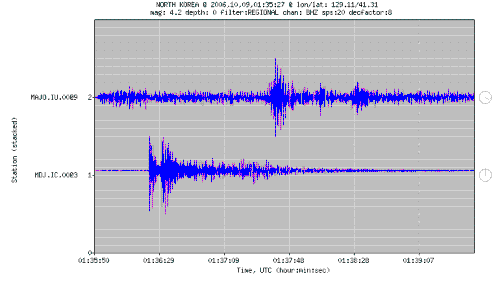
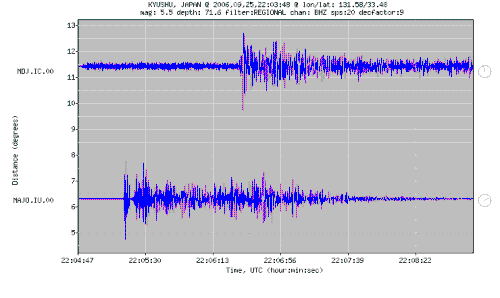
P waves are faster than S-waves, so will be the first to reach the station. It seems that for the North Korea event, a lot of the seismic energy received is in the first 10-15 seconds, and the signal dies out quite quickly after that. In contrast, the signal for the Japanese earthquake is received for more than 2 minutes, and the first peak is much less pronounced, suggesting that more energy is arriving in the form of slower S waves, and significant (above background) vibrations are received for a much longer period.
So, it seems likely that this is indeed an explosion, although that says nothing about whether the device actually worked; that would depend on knowing what the intended yield was, and even then it’s tricky, because not all of the energy released will be converted to seismic waves. This uncertainty may be behind the large discrepencies between the various estimates of the size of the explosion reported by New Scientist (see also the discussion at No Se Nada), which has led to speculation that the bomb might have ‘fizzled’. For what it’s worth, one of the textbooks on my desk says that a Hiroshima-size device (10-15 kT TNT equivalent) should generate a magnitude 5 quake, so if it didn’t fizzle, it seems to have been quite a small nuke.
09 October, 2006
UK successfully clones Discovery Institute
See also my update
I had this weekend all planned out: chill out for a bit, play around with next week’s lectures, maybe even finally sort out how to migrate everything over to Blogger Beta without destroying my layout. Unfortunately, the letters page of Saturday’s Times has sent me off on a slightly depressing tangent. Three letters were part of a continuing discussion about a story in the Times Education Supplement a week or two ago, about the recent activities of a group called Truth In Science.
Every secondary school in the UK has been targeted in a new campaign promoting the teaching of creationism in science lessons. Heads of science at 5,000 schools have been sent teaching materials casting doubt on Darwin’s theory of evolution and encouraging children to consider alternative interpretations of life on earth. A booklet and two DVDs, created by Truth In Science, an influential group of academics and clergymen advocating more “balance” in GCSE and A-level science, were mailed to private and state schools this week.
The discussion has led one of the members of the ‘scientific panel’ of Truth in Science to write in:
Truth in Science is seeking to enable school science students to follow the evidence for and against evolution wherever it leads.
We are committed to truthfulness and good science, and invite our critics to identify the alleged “scientific errors” of our website. Where convinced they occur, we will correct them.
Okay then.
I’ll ignore the fact that members of a group calling itself ‘Truth In Science’ have rather obviously failed to grasp the rather fundamental point that science is not engaged in a search for Truth, but models which have predictive and explanatory power. I’ll also pass over the fact that the first thing on their website (I’m not linking to it, but it's truthinscience.org.uk if you’re interested) is exactly the sort of weasel-like interpretation of a statement in the National Curriculum I feared when I first saw it (sometimes I hate it when I’m right). I’ll even be charitable and give them a pass on the fact that, for all their talk of misrepresentation of alternatives to evolutionary theory, there’s nary a mention of what they might be in their non-misrepresented form. Let’s instead examine a few items on the laundry-list rather bizarrely entitled ‘Evidence for Evolution’, which I suppose is trying to imply that it represents the best modern science has got.
- Antibiotic resistance:
Most types of antibiotic resistance were already in existence before antibiotics were discovered and used extensively to treat infectious diseases.
‘Most’ is pure weasel, hedging bets against the obvious rebuttals that antibiotic resistance does evolve. Of course, that’s only “microevolution” because “they’re still bacteria”. Clearly these guys haven’t seen that when it comes to diversity, bacteria beat us hands down – it’s just all at the biochemical level. - Comparative Genetics and Biochemistry
There is, of course, much dissimilarity between living organisms, some of these at a very fundamental level. For example, the standard system of genetic code used by humans is not universal. Eighteen different genetic codes have been found in various species. Many scientists see this as evidence that all life does not come from a single common ancestor.
Name some, please (biochemists, preferably). It’s true that some variations in the standard genetic code have been discovered, only a few of the 64 codons are different in any of these variants. Look, for example, at the mitochondrial genetic code; and here’s a full list of known variations and their taxonomic ranges. Note that most are found in bacteria and other single celled-organisms, which are merely microevolving so don’t count anyway. Yes, that was sarcasm. - The Fossil Record
The key problem is this: Darwin’s theory relies on minute changes in organisms which slowly accumulate, gradually changing the organism until it eventually becomes a new species. If this is correct, then the fossil record should contain many fossils with forms intermediate between different species. This is not what the fossil record shows.
One word: Tiktaalik (see also here. Or how about when whales went back the other way? Or the increasing cranial capacity of hominids?.
About half of the major animal groups appear, fully formed, in the Cambrian strata of rocks, with out any fossilised ancestors.
Wrong, unless you think tens of millions of years is ‘sudden’. And, at the time, all the major animal groups were ‘variations on a theme of worm’, anyway. There were no mammals, reptiles, birds, even insects, as we know them.
Well that wasn’t hard, and I could go on, but when I saw them harping on about Peppered Moths and Haeckel’s embryos, it became clear that this is just Jonathan Wells’ Icons of Evolution, redux, and that has been pretty finely shredded by people far more qualified than me - as has it’s new, unimproved incarnation.
Besides, I don’t want to rot my brain too much. I’m meant to be teaching actual science tomorrow.
06 October, 2006
Worship the awesome geo-nerd!
So says Kevin Vranes over at No Se Nada (OK, so I paraphrase a little...). Anyway, welcome to those who have got here from there - the highlights of my last year's ramblings are handily summarised here.
If you haven't, go and read his account of an interesting new paper by Latif et al., which tries to estimate the amount of multidecadal variability in the meridional overturning circulation (MOC). This is poorly known, which makes interpreting the results of Bryden et al.'s Nature paper rather difficult (Kevin's just reposted his take on this, which is similar to mine).
Their estimate is indirect: they've taken the fact that in climate models changes in the MOC are expressed as specific changes in sea surface temperature (SST) patterns, looked for this signal in actual SST records, and used that to estimate that the strength of the MOC might vary by 1.5–3 Sv (106 m3/s) over multi-decadal timescales. For reference, the reduction estimated by Bryden et al. was about 8 +/- 6 Sv.
What I'm still waiting for is the results from the moorings Harry Bryden deployed in 2004, which have been recording real-time data on the short-term (annual, monthly, daily?) variability of the MOC. As I commented over at No Se Nada, I've heard rumours that they've found some and it's significant; I'll revisit the issue when this paper is published (thanks to Steve Bloom for knowing his way around the NOC webpages better than me).
05 October, 2006
Mountain musings 2: What’s God got to do with it?
“Don’t these mountains make you think of God?”
I was asked this question by one of my walking companions as we lunched in front of a particularly awe-inspiring Alpine vista, on my recent excursion in the Vanoise National Park.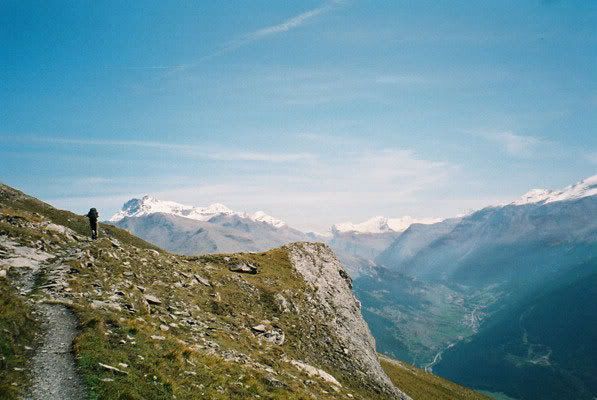
I paused, considering the most appropriate way to respond, before deciding that honesty was the best policy.
“Not really, no.”
My inquisitive companion is a good friend of mine from University, and an evangelical Christian. He was also, by way of a somewhat heated discussion on the virtues of radiometric dating on an earlier walking holiday, one of the people who first made me aware of the widespread sympathy for literalist biblical creationism amongst even moderate-seeming evangelicals. Fortunately, this conversation petered out good-naturedly (I don’t always pick fights for the sake of it), but it bothered me, I think because in some ways it encapsulates the tension between science and (some) religion.
As I was looking at those mountains, I was thinking of how millions of years ago, the limestone I was sitting on was slowly being formed in a shallow, long-vanished sea, before the ongoing collision between Africa and Europe forced it a mile up into the air, scrunching the beds up into crazy folds. I was taking in the myriad signs that the glaciers currently confined to the very highest peaks once carved out all the valleys we were looking upon, evidence of the waxing and waning of Quaternary glaciation. I was considering how, over millions of years, all of those peaks and cliffs would be ground back down to sea-level, just by the action of ice and water.
Purple prose aside, all this has a tendency to overwhelm thoughts like, “What pretty mountains God has made for me!” For a start, I know enough to be aware of the overbearing hubris in the notion that The Alps were put there for my benefit. They were here before our great-times-10 000-grandparents had sorted out bipedalism; they will still be here uncounted generations after we, and possibly our entire species, are dead. Yet despite that vast lifespan, the entire cycle of the birth and death of a mountain range represents only a tiny fraction of the history of our planet. That’s enough to prick anyone’s pretensions of grand cosmic importance, even without considering our decidedly non-privileged status in the Universe at large.
And herein lies the problem for many people. They don’t like to feel small and insignificant, and they certainly don’t like the theological implications of being such a tiny part of a universe so mind-bogglingly old and large and alien: namely, that if there is a God that set the whole thing in motion, it is just as mind-bogglingly vast and alien – and it may not consider us to be particularly important. For many people of faith, and evangelical Christians especially, the idea of a personal relationship with God is central to their lives; how can they feel close to such a distant and incomprehensible being?
(The ironic paradox, of course, is that this is exactly the fall-back excuse for the whole theodicy problem – bad things happen to good people because ‘God moves in mysterious ways’).
I wonder if this tension is the root cause of many of the characteristics of the modern evangelical: the suspicion or even outright denial of science, particularly evolution and geology; the biblical literalism (God is hardly detached and aloof in the Old Testament, is he?); and the readiness to see the presence of God in every innocent mountain (whilst pitying people like me, who don't).
Fortunately, the mountain doesn't care. It just is.
04 October, 2006
My academic life
Jorge Cham nails it as always, but this one has a particular resonance for me right now.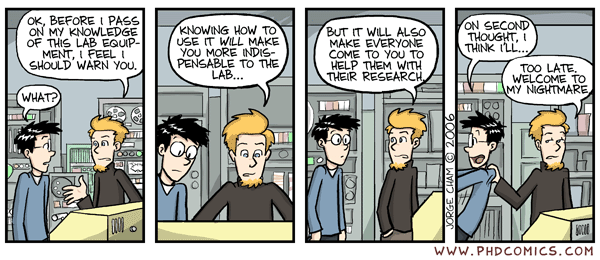
Of course, unlike Mike, I might actually leave someday.
01 October, 2006
One year on
A small problem with my new flat's electrics prevented me from exactly marking the anniversary of the post that started my little blog. After a shaky start, I have been much better in recent months at producing posts semi-regularly - at least, when I haven't been gallivanting off to some internet-deprived corner of Europe.
As befits my blog’s name, I’ve drifted a bit about through the many different disciplines which fall under the aegis of Earth Sciences. My interest in planetary geology has led to discussions of possible subsurface water on Mars, the past geological history of Titan, and, during the Pluto controversy this summer, how Ceres might be a worthy planet after all (sadly the IAU didn’t agree).
Back on Planet Earth, I’ve looked at the uncertainties behind the doom and gloom headlines about the collapse of the thermohaline circulation, and how even if it happened it wouldn’t be the Day After Tomorrow. I’ve also fixated a bit on the poor understanding of the science, and particularly the limits of earthquake and volcano prediction, one of the items in my list of annoying misconceptions in Geology leading to posts on a rather odd proposed earthquake precursor, the blend of luck and expertise whichled to an apparently accurate earthquake alert in China, and seasonal variations in the frequency of volcanic eruptions. And, in the run up to the UK government releasing a new, improved energy review, I took a skeptical look at their new-found enthusiasm for nuclear power, one of the valid objections to which isn’t that we’re running out of uranium.
Another thing I have noticed is that other than a short introduction to my own subdiscipline, paleomagnetism, I haven’t really talked about my own research, which is definitely something I want to rectify in a few months.
Whilst waiting around in Southampton to defend my PhD thesis, I’ve also been employed as lab-skivvy and teaching cover for my supervisor. It’s not always been easy, especially when I’ve been marking some rather poor exams, but it’s given me some important insights into the art of teaching science. And despite the odd moan, my position has had its compensations - a field trip or two, for example.
And, like most scientists nowadays, I’ve fretted over the rise of irrational thinking, particularly in the form of ‘Intelligent Design’, creationism with added nudges and winks. It seems the UK is not immune; but despite the warning signs, it appears that things are not as bad as they are across the Atlantic.
Of course, the fact I've been writing stuff says nothing about whether it's worth reading. That judgement, of course, is out of my hands.
27 September, 2006
Mountain musings 1: The hard climb of science
I’ve just spent a week hiking in the Vanoise National Park; we did a five day loop around the main glacial massif. On the whole, it was a thoroughly enjoyable experience; after an unpromising start the weather was fabulous, the scenery fantastic (I took an old film camera so no photos to show off as yet) and I had the unforgettable experience of a golden eagle flying 10 feet above my head, close enough to pick out individual feathers on his underbelly. I’m glad I didn’t look like lunch, although his long stare indicated he was thinking about it.
The hike was no without it’s challenges, however, and the second day was particularly hard work. On paper, it was difficult enough; 1200 m of ascent, including a stiff climb to 2916 m to get across the Col d’Aussois. In reality, we proceeded to make it even tougher for ourselves by getting un peu perdu. As we approached the Col, we lost the trail, but we could see a track going up the hillside across the river and decided that must be the route. We persevered with this belief even after we discovered that the bridge promised in our guidebook had apparently vanished; it was only when we’d spent an hour struggling up it - and reached a much lower col on the wrong side of some rather hefty mountains – that we realised that we’d gone a bit wrong. When we looked back into the valley, we could see the actual track, heading upwards into the next valley. Merde.
Fortunately, our elevated perspective also showed us that we didn’t have to completely retrace our steps, an option almost as unpalatable as heading on and trying to find another route across the ridge; instead, we just had to descend enough to contour around into the next valley, and then re-ascend to rejoin the trail up to the Col d’Aussois after it crossed the river (on a very existent bridge). Despite this short cut we lost almost two hours, and fretting over time combined with tiredness from our abortive first ascent, the altitude, and an unrelentingly steep path to make the ascent to the top of the proper col one of the toughest things I’ve done in quite a while. My world contracted in on itself; the track was reasonably well marked by cairns, and rather than focussing on the distance to the summit, my mind was fixated on driving myself onward to the next cairn, and then the next one, and then the next one… all the time my breath was getting shorter, my rucksack was getting apparently heavier, and lifting my feet was becoming ever more difficult. And then, just when I thought I’d reached the top, I struggled over the break in slope to discover yet more up. By this stage, it’s only slightly melodramatic to claim that the point of the ascent was only a dim recollection in the back of my mind; pretty much the only thought in my head was, “I’m not going to let this bloody hill beat me!”
By 7.30, we’d all got to the top. Unfortunately, that was not the end; we now had to descend down to the refuge on the other side of the col. Down was good (although gravity can be a fickle friend when you’re knackered), but we had the small problem of about 90 minutes’ walking and half an hour of daylight left to do it in. Fortunately, thanks to one of my companion’s inspired twilight route-finding, we only needed our torches for the last 20 minutes, but even so we almost overshot our destination.
In the end, what should have been an eight hour trek had taken almost 12. However, although negotiating mountain trails in the dark is hardly recommended, we were never really in serious trouble; as a tale of danger and fortitude, this is hardly Touching the Void territory. However, looking back as the hike continued, I found myself thinking back to a post I started writing a few weeks back, discussing the vast gulf between the public perception of science and the process of actually doing science*, and I couldn’t help drawing parallels between that the physical ordeal of that day and the mental struggle of a PhD, or any research project. You start at the bottom of a big hill, and despite previous research as a guide the way forward is not clear (especially if you don’t find the key publication, as we neglected to properly consult the map). When a route does present itself, it may not be the correct one, and it may take you considerable time and effort to discover this. Your wrong paths may not be a complete dead end; a negative result can still constrain the problem, or (as happened during my PhD), the result which undermines a key assumption may finally reveal the true path to understanding. It’s disturbingly easy to get so lost in the day-to-day grind of generating and processing data, that you almost lose sight of the reasons you were interested in the first place. Just when you think you’ve got there, you discover a new complication with your data. And, of course, it takes much longer than it was supposed to.
If I really wanted to get lost in the metaphor, I could run with the whole “standing on the shoulders of giants” angle by musing that the hard day’s climbing gave us access to some spectacular mountain scenery in the following days. That, however, is somewhat immaterial to my point. I’ve often thought that a shortcoming of most science reporting, centred as it is around (if we’re lucky, informed) regurgitation of Nature press releases, is that it is exclusively concerned with the outcomes: the exciting results and nifty new hypotheses. Results are important, of course, but I sometimes think that focussing only on the final part of the scientific process means that many people do not realise exactly how many years’ graft has gone into attracting the public attention for that fleeting second (if it ever does). A scientist’s week does not consist of thinking up a nifty idea on Monday, running down to the lab and testing it on Tuesday and Wednesday, writing it up on Thursday and getting the plaudits on Friday. The view is great from the top - but it takes a whole lot of climbing to get there.
*Yes, I was thinking about blogging. But a nice walk has always provided good thinking time for me, so it’s not quite as sad as it might appear. Honest.
16 September, 2006
Gone roamin'
It's been a busy few days, as I've been trying to get stuff finished before I head off to do some walking in the French Alps. Lets hope the weather smiles on me.
Those needing their fix of top-notch writing can do worse than head over to the first edition of Philosophia Naturalis, the long-awaited physical sciences carnival now up over at Science and Reason. Tell them I sent you.
13 September, 2006
The curse of the nerd
There’s a lot of posturing at the moment over at Scienceblogs (follow the links here, for example) over who is the nerdiest of them all. In some ways, this is an encouraging affirmation of the universal characteristics of human nature. Change a few key terms, ‘slide rule’ to ‘alloys’, for example and you could be in the streets of Essex listening to teenagers showing off their latest set of wheels. We just can’t resist the urge to shout about what hot stuff we are, even if the requirements within different social groups are somewhat different.
Over at Cosmic Variance, where Sean has an interesting take on the whole exercise:
I’m all in favor of celebrating nerdliness. But for me it’s very much a part of what should be a general appreciation for intellectual endeavor, whether technically oriented or not. And as a matter of personal experience, I’ve found science and engineering types to be at least as anti-intellectual as the average person on the street, when it comes to non-technical kinds of scholarship.
What is worse, there’s a certain point of view… that actually celebrates social awkwardness for its own sake... And that’s just wrong. I’m not talking about principled eccentricity, letting your freak flag fly — nothing wrong with that, in fact it’s admirable in its own way. Nor am I saying that everyone should be scouring the latest issues of GQ and Vogue for fashion tips; superficiality is just as bad as nerdliness. And laughing at our high-school (and college) selves is always fun and healthy. All I’m saying is that there is much to be valued in an ability to relate to other kinds of people in a disparate set of circumstances, take care of your appearance, and function effectively in a wider social context. These are skills we should try to cultivate, not disparage.
How true. One of the more unpleasant aspects of working in academia is that bullying, petulance and general obnoxiousness is an accepted (or, at best, tolerated) way of progressing in your field. In my department, I find myself in the odd and entirely undeserved position of being at the high end of the social skills spectrum, which even my best friends in the real world would tell you is a little frightening.
But why is this? I think this actually does link back to the somewhat negative stereotypes at large in general society: scientists as bumbling, socially inept and desperately uncool loners; science students as all of the above with added spots, crooked teeth and thick glasses. This is not an image your average teenager, highly susceptible to the ebb and flow of peer approval, wants associated with them, thanks very much. Hence even if there is a genuine interest, many do not persist in science (or, more accurately, put in enough work to leave the option open). Those who do are either comfortable enough with themselves to follow their interests despite peer pressure, or lack the social awareness to perceive or care about it*. I would submit that the latter group is by far the larger.
So it’s all a bit circular really – through this process of self-selection, those on the path towards a scientific or technical career are on average more socially inept than the general population. Within the group poor social skills are the norm, so they persist, reinforcing the general cultural stereotype and keeping scientists 'uncool'. Additionally, within the group there is also a backlash against other parts of culture, seemingly the preserve of people who look down on the science geek; hence the apparently contradictory anti-intellectualism that Sean notes. Breaking that circle is not an easy thing.
*Or you're such a well-known swot that you can choose to do what you like, in the certain knowledge that nothing you do will change people's perceptions of you.